Information checked as of 13 August 2026. An electric vehicle can reach the end of its road life while its traction battery still contains usable cells and valuable materials. The responsible next step is a controlled chain: identify the pack, make it safe, assess its condition, choose continued use, repurposing or material recovery, and document the destination.
China, the European Union, the United States and Japan all pursue that chain, but assign responsibility differently. China combines producer take-back with national traceability. The EU uses binding extended producer responsibility and quantified recovery targets. The United States applies federal waste and transport rules alongside state programmes. Japan combines a legal dismantling duty with manufacturer-supported collection and standards for safe reuse.
None of these systems makes an old EV battery pollution-free. Collection uses energy; damaged packs can burn; shredding creates dust; thermal and chemical recovery can produce emissions, wastewater and residues. Well-run recycling reduces uncontrolled disposal and recovers materials while controlling these risks. That is a genuine environmental benefit, not "zero pollution."
End of vehicle life is not always end of battery life
A battery should not be repurposed merely because the vehicle is old, or shredded merely because range has declined. The decision depends on identity, chemistry, state of health, safety indicators, repair history, physical damage, water exposure and the requirements of the intended use.
There are three broad routes. A sound pack may remain in the vehicle or be repaired by qualified technicians. A suitable pack or selected modules may be evaluated for a less demanding product such as stationary storage. An unsafe, unsuitable or uneconomic pack may be processed for materials. China’s EV battery-health assessment framework can improve evidence at this decision point, while its battery durability standard concerns durability testing of new batteries. Neither makes a used pack automatically fit for second life.
"Second life" is a possible outcome, not a safety grade. A storage integrator still needs diagnostics, compatible controls, a defined operating window, product conformity and an end-of-life route. Without that evidence, material recovery may be safer.
The chain from vehicle to recovered material
- Identify. Match the VIN, battery code, chemistry, capacity, manufacturer and owner; preserve chain of custody.
- Screen hazards. Isolate packs that are damaged, swollen, leaking, overheated, recalled, submerged or of unknown condition.
- Stabilise and transport. Qualified staff isolate high voltage and select suitable packaging and transport controls.
- Diagnose and route. Use traceable data and inspection to choose continued use, repair, compliant repurposing or recycling.
- Dismantle and recover. A permitted facility separates components and processes cells or active material mechanically, thermally, hydrometallurgically or directly.
- Treat emissions and residues. Wastewater sludge, filters, slag and other residues need lawful management.
This is industrial high-voltage and hazardous-material work, not a do-it-yourself procedure. A general workshop is not automatically qualified to open or shred a traction battery.
Four systems at a glance
| Market | Collection responsibility | Treatment framework | Distinctive feature |
|---|---|---|---|
| China | Battery and vehicle producers establish take-back networks where they sell. | Traceable hand-off to lawfully established comprehensive-utilisation businesses with environmental approvals. | National life-cycle platform and battery digital identity. |
| European Union | Producers finance free take-back of waste EV batteries. | Permitted treatment, landfill and energy-recovery ban, and quantified targets. | EU-wide recovery targets, recycled-content rules and a battery passport. |
| United States | Manufacturer, recycler and state arrangements vary. | Federal and state waste rules plus dangerous-goods transport rules. | Growing capacity within a state-by-state policy landscape. |
| Japan | Dismantlers remove drive batteries; participating automakers use a joint collection system. | Automobile-recycling duties, controlled logistics and manufacturer procedures. | Coordinated collection and international guidance for reuse evaluation. |
This compares regulatory architecture, not environmental performance. A target, installed capacity or count of collected packs is not a verified national recycling rate.
China: producer responsibility and traceability
China’s 2026 Interim Measures for waste NEV traction batteries took effect on 1 April 2026. Battery producers must provide collection points in provincial-level regions where they sell; vehicle manufacturers must provide them in prefecture-level cities where they sell, with networks matched to sales.
The measures require reporting through a national traceability platform and introduce a battery digital identity. Repairers, swap operators, dismantlers and utilisation businesses have defined hand-off duties. A scrapped NEV is incomplete if its traction battery is missing; retired traction batteries may not be diverted into electric bicycles. Comprehensive-utilisation businesses need project filing or approval, an environmental-impact assessment, environmental and safety facilities, and a discharge permit or registration.
Screening may identify an input for a compliant new product, but the current rule governs that product by the standards of its intended use. It does not use "cascade utilisation" as a blanket safety assurance.
At a January 2026 briefing, the Ministry of Industry and Information Technology reported more than 400,000 tonnes comprehensively utilised in 2025, up 32.9%, with collection networks covering all 31 provincial-level regions. This is processed volume, not a national collection rate; it should not be divided by a separately estimated generation figure.
A voluntary Chinese industry benchmark, effective from 2025, includes at least 98% electrode-powder recovery, at least 90% lithium and 98% nickel, cobalt and manganese recovery in metallurgical processing, and at least 90% process-water recirculation for admitted companies. Admission is voluntary, not an operating licence, and these are not results achieved by every recycler.
European Union: free take-back and targets
The EU Batteries Regulation (EU) 2023/1542 applies extended producer responsibility; its waste-battery chapter has applied since 18 August 2025. Producers pay collection and treatment costs. Waste EV batteries must be accepted free, without requiring a new purchase, and sent to permitted treatment. Landfilling and energy recovery of waste batteries are prohibited.
For lithium-based batteries, recycling efficiency must reach 65% of average battery weight by the end of 2025 and 70% by 2030. Material-recovery targets are 90% for cobalt, copper, lead and nickel and 50% for lithium by the end of 2027; by 2031 they rise to 95% and 80% respectively.
The official EU calculation methodology excludes substances emitted to air, water or soil from recovered output. Meeting a target does not mean a process has no emissions.
From 18 February 2027, EV batteries placed on the EU market are scheduled to have an electronic passport. Our EU battery passport guide explains why identity and data support due diligence but cannot replace a current assessment. The Regulation also phases in recycled-content requirements for cobalt, lead, lithium and nickel.
United States: waste controls and state policies
The United States had no EU-style nationwide EV-battery EPR law or mandatory national recovery percentage on the checked date. EPA is developing a voluntary federal battery EPR framework, while states may impose additional rules.
EPA says most discarded lithium-ion batteries are likely hazardous waste because of ignitability or reactivity, D001 and D003. Its official recycling FAQ says qualifying batteries may use streamlined federal universal-waste rules during collection, but must reach an appropriate hazardous-waste destination or recycler. An ordinary universal-waste handler cannot shred them into black mass. States may be stricter.
EPA’s 2026 report to Congress says there is no commonly accepted US lithium-ion recycling rate; the often-repeated 5% figure came from older European data. Capacity is different: the Department of Energy reported 35,500 tonnes of US material-recycling capacity in 2023, with 76,000 tonnes announced or planned. That is capacity, not throughput or yield.
New Jersey describes its 2024 law as the first state EPR law for EV and hybrid traction batteries. Its programme includes a landfill ban from 8 January 2027. Transport is separate: US Department of Transportation rules treat lithium batteries as hazardous materials.
Japan: dismantling duties and joint collection
Japan’s Automobile Recycling Law framework requires authorised dismantlers to remove drive batteries. Since October 2018, participating manufacturers and importers have used the Japan Auto Recycling Partnership collection system; qualifying batteries from participating brands are generally collected without charging the dismantler.
The layers should not be conflated. Removal during authorised dismantling is a legal duty; the producer-funded JARP route is a coordinated industry mechanism, not the same model as EU-wide statutory EPR. Official reporting recorded 13,135 batteries collected through the joint system in 2024, including 387 damaged, deformed, leaking or submerged units. Those are units, not tonnes or a national recovery rate.
Japan led IEC 63330-1, published in June 2024. METI’s explanation describes appearance checks and use of manufacturer history and operating boundaries when evaluating EV batteries for stationary reuse. It supports disciplined routing, not a guarantee that every pack is reusable. We found no nationwide mandatory EV-battery material-recovery percentage comparable to the EU targets.
What happens inside a recycling plant?
Mechanical preparation
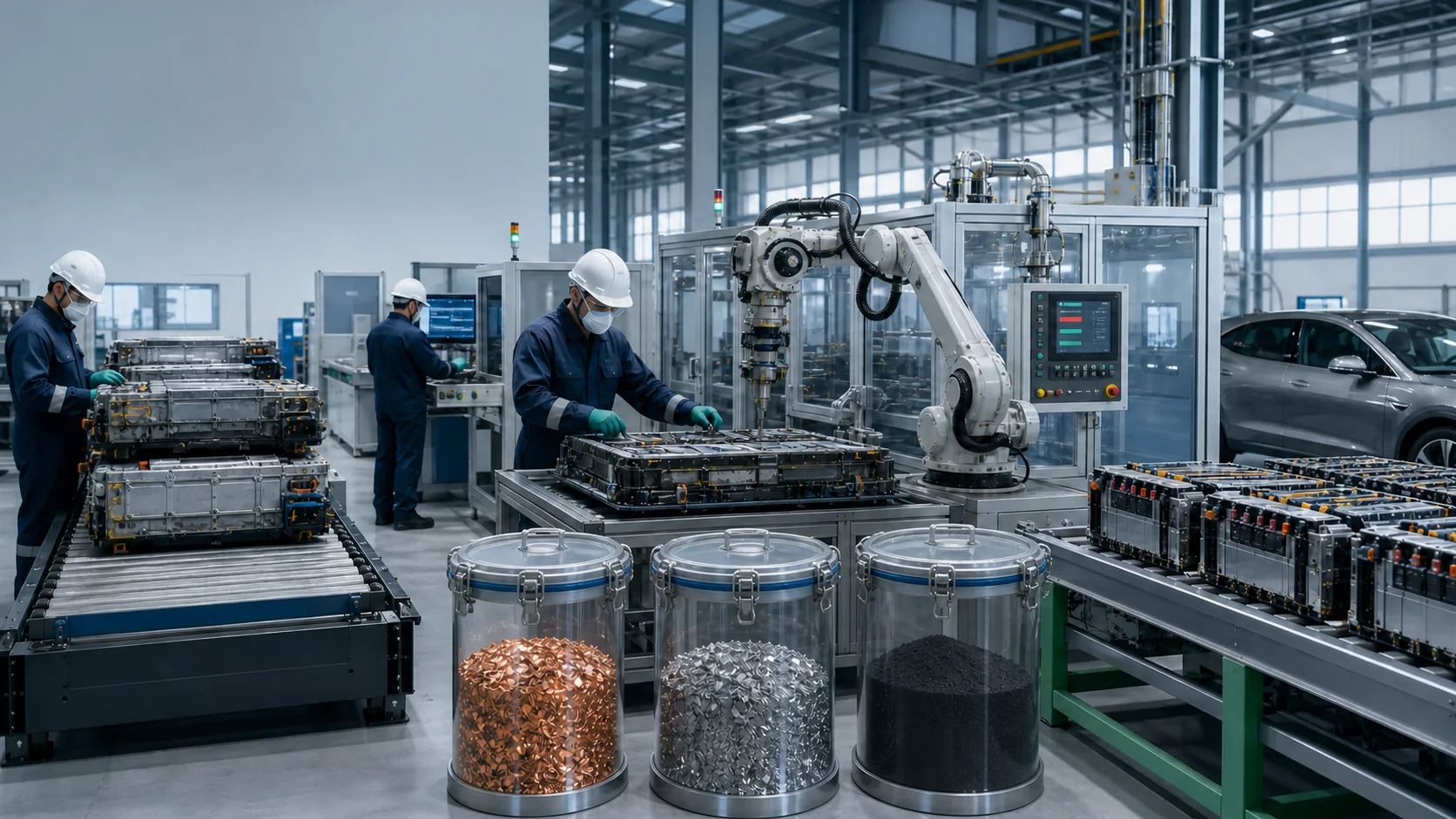
After safe reception and discharge, a facility can separate housings, wires and electronics before controlled crushing. Physical separation recovers steel, aluminium and copper and concentrates active material into "black mass." Black mass is an intermediate, not proof that its metals have returned to a new battery.
Pyrometallurgy and hydrometallurgy
High-temperature processing can accept mixed feed and recover selected metals, but uses substantial energy and requires gas treatment; some materials may remain in slag. Aqueous leaching can recover lithium, nickel, cobalt and manganese at high purity, but consumes reagents and creates liquid streams requiring recycling or treatment. Environmental performance depends on the plant’s energy, yield, water and residue management.
Direct recycling
Direct methods try to preserve or restore cathode material instead of reducing it fully to metals. EPA describes this route as smaller-scale. It may reduce steps for compatible, well-characterised feed, but mixed chemistries, contamination and product specifications remain obstacles. No route is automatically best for every NMC, LFP or other battery.
Pollution risks and controls
Risk begins before processing. Damaged packs can enter thermal runaway in storage or transport. Electrolyte, fluorinated compounds, dust and contaminated fire water threaten workers and the environment. Thermal processing creates gases and particulates; wet processing can create acidic or alkaline wastewater; all routes leave filters, sludge, slag, plastics or other residues.
China’s Ministry of Ecology and Environment standard HJ 1186-2021 illustrates credible controls: incoming inspection; dedicated isolation of leaking, smoking or damaged batteries; controlled dismantling; negative-pressure processing for electrolyte-containing cells; impermeable floors; rainwater-wastewater separation; exhaust collection; wastewater treatment; segregated waste storage; and emissions monitoring. Intact packs and modules should not be directly roasted.
Responsible recycling can avoid dumping, reduce fires in ordinary waste systems, displace some virgin extraction and return materials to production. It also consumes resources and can transfer pollution if controls fail. Claims should use facility-specific recovery data, lawful residue destinations and transparent life-cycle analysis where appropriate.
Buyer and exporter checklist
- Identify the pack. Record VIN, model, battery code, chemistry, capacity and owner.
- Request dated evidence. Ask who diagnosed it, by what method and whether the result matches the identified pack.
- Check abnormal history. Obtain collision, water, overheating, repair, replacement and recall records. China’s EV battery safety standard is context, not a used-pack certificate.
- Define the hand-off. Name an authorised take-back point, repurposer or recycler that accepts the chemistry and condition.
- Verify authorisation. Check the facility’s legal identity, environmental or waste permissions and downstream destinations. A voluntary list is not a permit.
- Keep chain-of-custody records. Retain identifiers, transfer records, weights or counts, incident notes, treatment certificates and mass-balance evidence.
- Separate reuse from waste shipment. "For second life" needs test evidence, a real product destination and applicable conformity; wording cannot bypass waste controls.
- Plan transport. Condition, charge, packaging, carrier and route matter. For a battery installed in a vehicle, start with our IMDG 42-24 checklist; removed or damaged batteries need separate specialist review.
- Check both jurisdictions. Export, transit and destination requirements can differ. Confirm with carriers, recyclers and authorities.
- Use a complete procurement gate. Combine battery evidence with identity, condition and documents using our used-EV export readiness checklist.
The practical conclusion
China’s strength is binding traceability and a producer network at market scale. The EU is clearest on harmonised responsibility and recovery targets. The United States combines industrial investment and hazardous-material controls, but nationwide percentage comparisons remain weak. Japan shows the value of coordinated logistics and careful reuse evaluation, though unit counts are not material yields.
Across all four, the credible green hierarchy is the same: keep a safe battery in productive service when evidence supports it; repurpose only through a controlled product pathway; recover materials in permitted facilities; and account honestly for emissions and residues. That approach is circular and pollution-controlled. It is not pollution-free.
Sources and methodology
This comparison uses official information available on the checked date: China’s MIIT measures and briefing and MEE pollution standard; the EU Batteries Regulation and calculation method; US EPA, DOE and New Jersey materials; and Japan METI and JARP materials. Numeric values retain each source’s unit and scope. We do not derive recycling rates from figures with different years, boundaries or definitions.
This original overview is for professional vehicle buyers and exporters. It is not engineering, dangerous-goods, waste-shipment or legal advice, does not certify a battery or recycler, and does not replace destination-specific advice from qualified specialists and authorities.