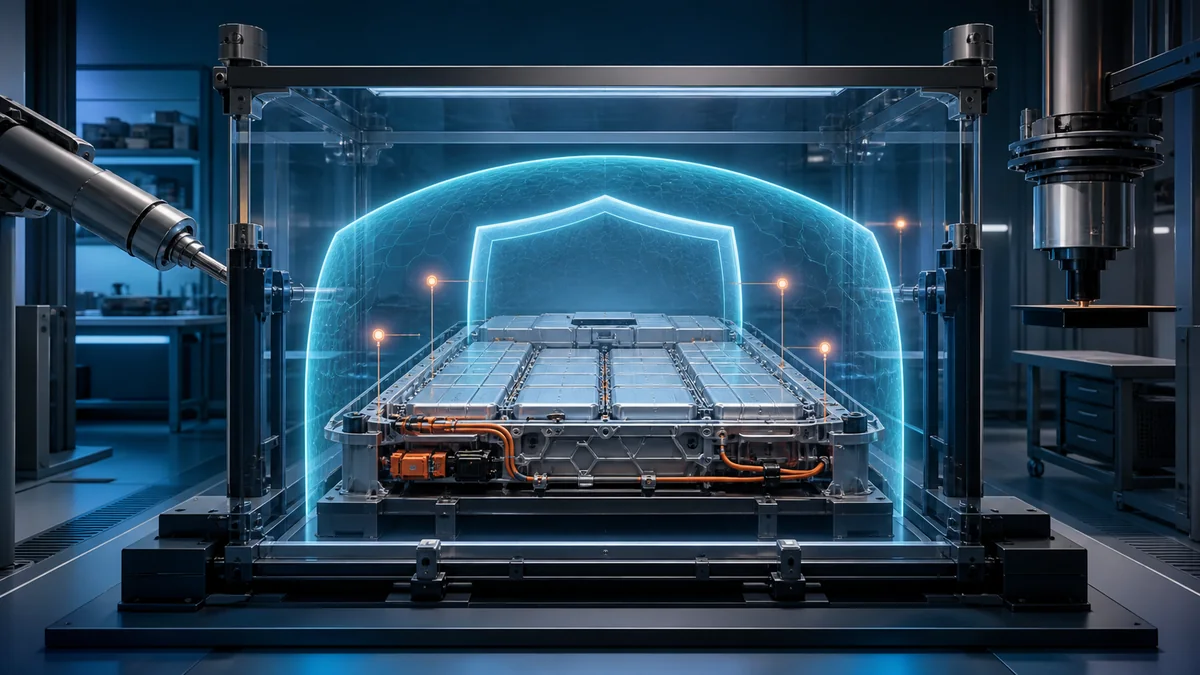
Effective 1 July 2026. China's mandatory national standard GB 38031-2025, Electric Vehicles Traction Battery Safety Requirements, is now in force. It replaces GB 38031-2020 and sets safety requirements and test methods for traction-battery cells, packs and systems used to propel electric vehicles.
The standard is relevant to overseas buyers because it shows how China's type-level battery safety baseline has changed. It does not certify the present condition of every used EV, and it should not be confused with the separate battery durability standard already discussed on this site. Safety testing, durability measurement and an individual vehicle's state of health answer different questions.
What changed in the safety standard
Official explanations identify three especially visible revisions. First, the thermal-propagation requirement was strengthened. The earlier approach required a warning signal at least five minutes before fire or explosion. The 2025 standard requires no fire or explosion during the specified test, while retaining the warning requirement and addressing the effect of smoke on occupants.
Second, the standard adds a bottom-impact test intended to evaluate the protection of a battery pack when its underside is struck. Third, it adds a safety test after repeated fast charging: after 300 fast-charge cycles, the cell undergoes an external short-circuit test and must not catch fire or explode.
The official standard interpretation also lists tests covering over-discharge, overcharge, external short circuit, heating, temperature cycling, crushing, vibration, mechanical shock, simulated collision, humidity and heat, water immersion, external fire, thermal shock, salt spray and high altitude. The exact procedures and scope should be read from the official text rather than reconstructed from marketing summaries.
Safety is not durability
GB 38031-2025 is a mandatory safety standard. It is not the same as GB/T 46991.1-2025, the recommended durability standard that addresses capacity retention over specified service conditions. A battery can satisfy a type-level safety requirement without a seller proving the remaining capacity of a particular used pack. Conversely, a state-of-health percentage does not establish compliance with every safety test.
Buyers should therefore avoid claims such as "this car has the new safe battery" unless documentary evidence links the exact vehicle version and production status to the applicable standard. The effective date of a national standard is not a universal statement that every vehicle built before or after that date has identical hardware, certification or test history.
What the standard can and cannot tell a buyer
- It can identify the mandatory Chinese safety baseline and the types of tests required within its scope.
- It can help a buyer ask whether an exact model and build is covered by the relevant type or conformity documentation.
- It cannot provide the current battery state of health, repair history or damage status of a used vehicle.
- It cannot confirm charging compatibility, type approval or registration eligibility in the destination country.
- It does not replace an inspection after a collision, water exposure, battery repair or warning event.
Practical used-EV checks
Start with the VIN, build date, original Chinese model and precise trim. Request the battery chemistry, nominal capacity and pack identifier when source records make them available. Ask for a dated diagnostic report that identifies the vehicle, odometer reading, test method and measured result. A dashboard estimate or an unattributed percentage is not enough for a professional condition decision.
Review available service and repair records for battery removal, module replacement, underbody impact, water intrusion, high-voltage faults and thermal events. Include the battery enclosure and underside in the inspection scope. Confirm that warning lamps and diagnostic trouble codes have been checked rather than merely cleared.
For export, separately verify the charging inlet, AC and DC protocols, voltage support, destination infrastructure and any adapter solution. Review local rules for battery transport, vehicle conformity and registration. If the destination uses a different approval system, a Chinese national standard may support technical research but does not automatically grant destination approval.
How to describe compliance accurately
A careful listing or quotation should state only what the available evidence supports. It may identify the standard that applies to a documented vehicle type, cite a test or conformity record, and separately report the result of an individual battery diagnostic. If evidence is unavailable, say that verification is pending. Do not turn a national standard into a warranty or a claim about unseen battery condition.
Sources
- SAMR official record for GB 38031-2025
- Chinese Government English-language explanation of the new tests
- National Standards platform interpretation of GB 38031-2025
- Official publication notice for the standard text
This article is an original technical briefing based on official sources. It is not a safety certification, vehicle inspection, legal opinion or guarantee for any individual battery or destination market.