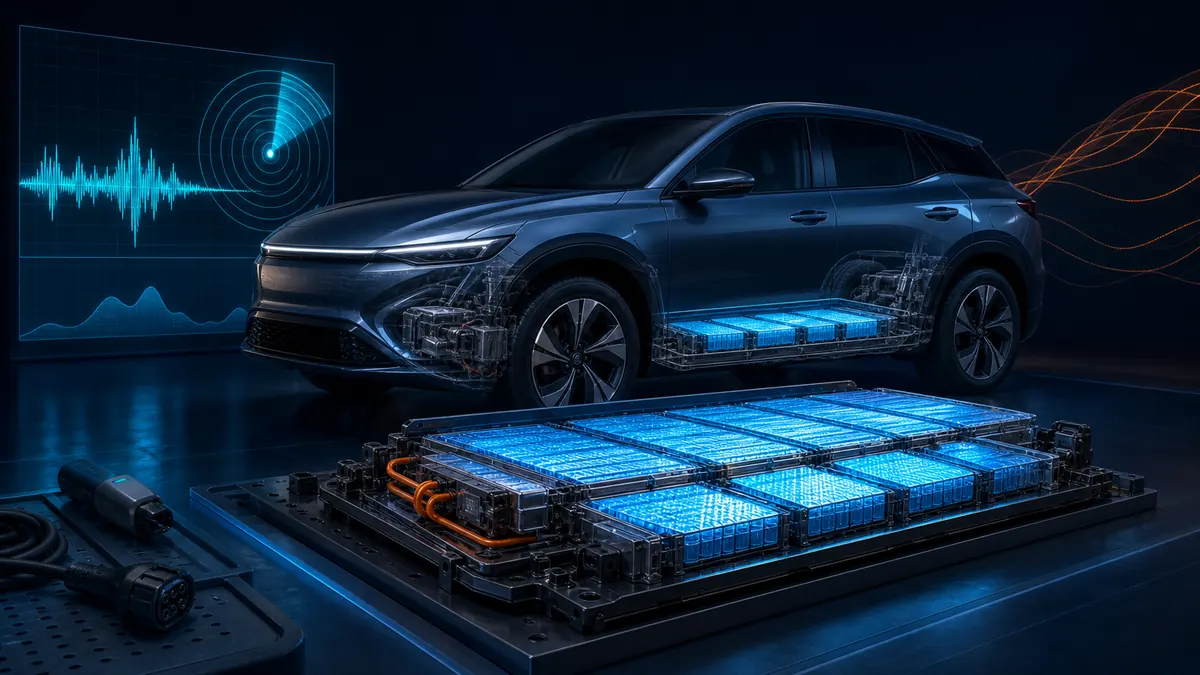
Information checked as of 9 August 2026. China’s GB/T 47136-2026 gives the used-EV market a more structured vocabulary for discussing traction-battery health and safety. For an overseas buyer, its value is practical: it can improve the questions asked before a quotation. It does not turn a used battery into a certified, risk-free product.
What the official standard establishes
The State Administration for Market Regulation and the Standardization Administration issued GB/T 47136-2026, Specification for health and safety states assessment of traction battery for battery electric vehicles, on 28 January 2026. It took effect on 1 May 2026 and is listed as a current recommended national standard.
The scope covers assessments based on operating data from traction batteries in in-service battery-electric vehicles. It directly addresses ternary-lithium and lithium iron phosphate batteries; other battery types may refer to it. The standard separates health-state assessment from safety-state assessment and provides a framework for results and reports. That distinction matters: remaining usable performance and indicators of safety risk are related, but they are not the same claim.
Two related official references help with identity checks. GB/T 34014-2017 provides the coding rules for automotive traction batteries. GB/T 47591-2026, issued and effective on 30 April 2026, concerns information on battery plates, labels and electronic identification. These standards can support traceability, but a code or label alone does not establish the present condition of a pack.
What changes for a professional buyer
A supplier may have a standard-based assessment, a manufacturer diagnostic record, a workshop report or only limited operating information. Buyers should name the evidence they received rather than describing every document as a “battery certificate.” GB/T 47136-2026 does not mean that every used EV offered for sale must automatically arrive with a completed report, and it does not make reports produced by different tools automatically comparable.
The useful question is therefore not simply “What is the battery health?” It is: who assessed the battery, on what date, at what odometer reading, from which data, under which method, and to which identified vehicle and pack does the result belong?
Buyer checklist before approving a vehicle
- Match the vehicle: reconcile the VIN, original Chinese model and variant, manufacture date, first-registration date and current odometer reading.
- Match the battery: request the battery chemistry, rated capacity and available pack code, serial number, label or electronic identifier. Record when an identifier cannot be inspected.
- Identify the report: retain the report title, issuing organization, assessment method, issue date and any stated validity or limitations.
- Record the data window: ask whether the result comes from live inspection, vehicle operating data, a BMS download or another source, and note the period covered.
- Disclose interventions: request records of pack, module or BMS replacement; high-voltage repair; water exposure; collision repair; overheating warnings; and relevant recalls.
- Keep source evidence: preserve the dated report or diagnostic output rather than transferring only a rounded percentage into a sales sheet.
- Escalate inconsistencies: if the pack identity, mileage, service history and diagnostic result do not align, pause the purchase and obtain a qualified inspection.
How to read a result responsibly
A health result is a dated assessment, not a prediction of fault-free life. Battery condition can change with subsequent use, storage, temperature, charging behaviour, damage or repair. A safety result is also limited by the input data and inspection scope. Neither one replaces a physical condition inspection when the transaction risk justifies it.
Do not compare two percentages unless the underlying definitions and methods are known. If one vehicle has a standard-based report and another has a dashboard estimate, present them as different evidence types. If no reliable result is available, say “battery-health report not available” instead of inventing a grade.
Limits and destination checks
GB/T 47136-2026 is a recommended Chinese national standard, not a mandatory export approval and not destination-country homologation. It does not prove charging compatibility, road registration eligibility, maritime acceptance, customs treatment or compliance with another country’s consumer and product-safety rules. Buyers should confirm those matters separately with the relevant authority or qualified adviser.
This article is an original procurement guide, not legal, engineering or safety advice. It does not certify any vehicle or battery. A purchase decision should be based on the identified vehicle, dated evidence, transaction terms and destination requirements.
Sources