
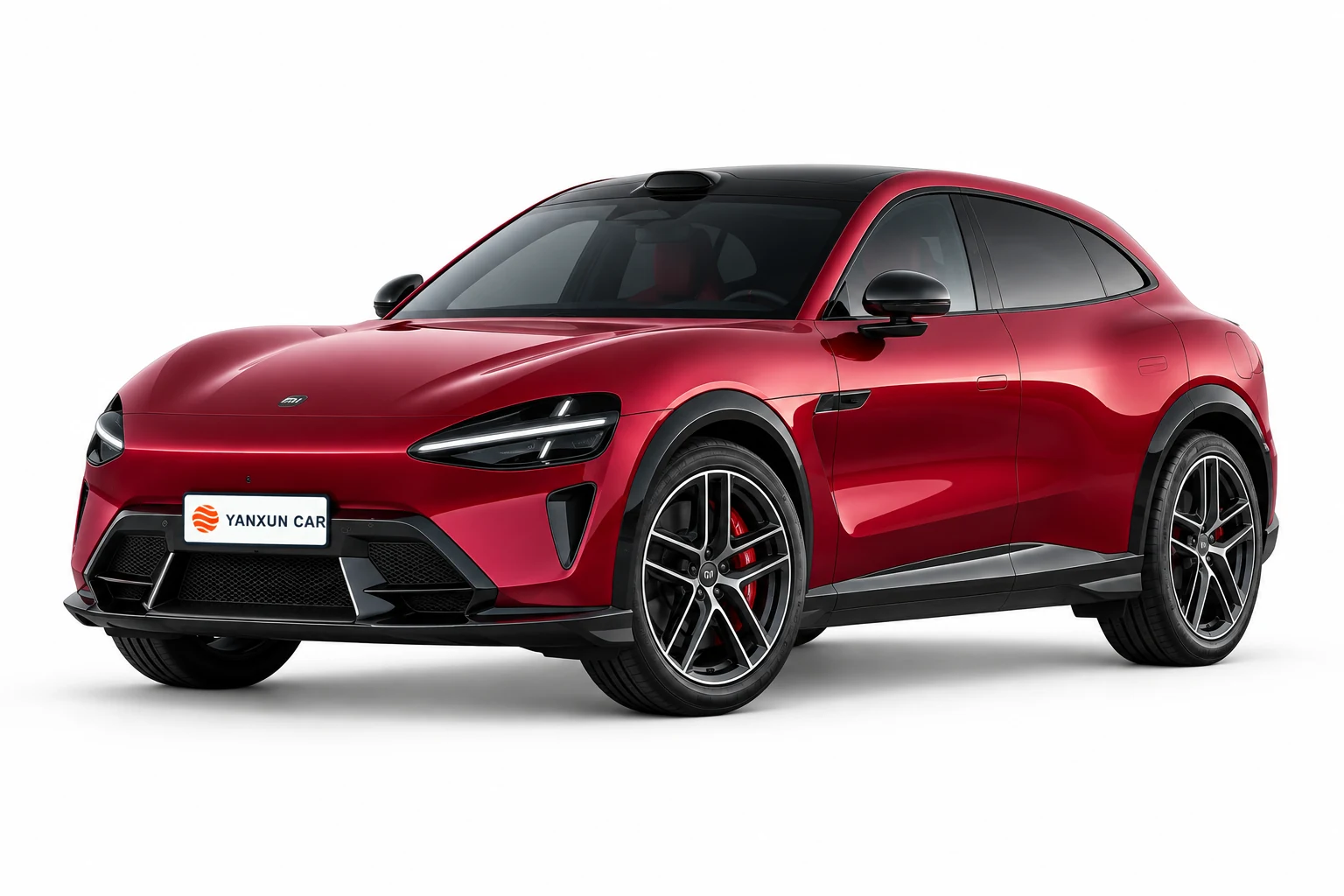
2026 Xiaomi YU7 at a glance
| Vehicle type | Five-seat mid-to-large battery-electric SUV |
|---|---|
| Current China-market family | Standard, Long Range, Pro, Max and GT |
| Length × width × height | 4,999 × 1,996 × 1,600 mm; GT 5,015 × 2,007 × 1,597 mm |
| Wheelbase | 3,000 mm |
| Battery range | 73.0, 96.3 or 101.7 kWh |
| CLTC range | 643 to 835 km, depending on version and wheels |
| Drive | Rear-wheel drive or dual-motor all-wheel drive |
| Maximum output | Up to 738 kW / 1,003 PS in YU7 GT |
| Fastest 0–100 km/h | 2.92 seconds in YU7 GT |
| High-voltage platform | 752 V or 800 V-class SiC; up to 897 V on Max and GT |
The Xiaomi YU7 is a low-roof, long-wheelbase electric SUV that combines sports-car proportions with family-car space. The 2026 line-up is broader than the original three-version launch range: a lower-capacity Standard reduces the entry point, the 835 km Long Range prioritises distance, Pro adds all-wheel drive, Max combines performance with very fast charging, and GT turns the same basic architecture into a 1,003 PS flagship.
Five versions: key technical comparison
| Version | Drive | Battery | CLTC range | Output | 0–100 km/h |
|---|---|---|---|---|---|
| YU7 Standard | RWD | 73.0 kWh LFP | 643 km | 235 kW / 528 N·m | 5.9 s |
| YU7 Long Range | RWD | 96.3 kWh LFP | 835 km | 235 kW / 528 N·m | 5.9 s |
| YU7 Pro | AWD | 96.3 kWh LFP | 770 km | 365 kW / 690 N·m | 4.3 s |
| YU7 Max | AWD | 101.7 kWh NMC | 760 km | 508 kW / 866 N·m | 3.23 s |
| YU7 GT | AWD | 101.7 kWh NMC | 705 km | 738 kW / 1,068 N·m | 2.92 s |
These are China-market figures. Wheel and tyre choice can reduce the nominal range: larger, wider performance tyres trade some efficiency for grip. The five versions therefore cover three distinct priorities—lower battery cost, maximum range, and progressively stronger dual-motor performance—without changing the five-seat cabin format.
Dimensions, aerodynamics and packaging
- Standard body: 4,999 mm long, 1,996 mm wide and 1,600 mm high, with a 3,000 mm wheelbase.
- GT body: 5,015 mm long, 2,007 mm wide and 1,597 mm high because of its more aggressive bumpers, track and aero package.
- Drag coefficient: Cd 0.245 for the regular YU7 under Xiaomi's test configuration.
- Aero hardware: 10 through-flow channels, 19 air outlets, an active grille with 100 positions and more than 40 optimised areas.
- Wheels: 19-, 20- and 21-inch designs are available; the GT can use forged 21-inch wheels.
- Turning circle: approximately 5.7 m, useful for a vehicle almost five metres long.
The 1:3 wheel-to-body proportion, long bonnet and low glasshouse make the YU7 look closer to a raised grand tourer than a conventional upright SUV. The clamshell aluminium bonnet measures 3.11 m², while the 22-degree ducktail, hollow spoiler and controlled air paths contribute to the low drag figure.
Standard and Long Range: the rear-drive choices
The 2026 Standard uses a 73.0 kWh LFP battery, a 752 V silicon-carbide platform and a 235 kW rear motor. Its 643 km CLTC rating is lower than the rest of the family but still substantial, while the same NVIDIA DRIVE AGX Thor hardware, LiDAR and Xiaomi HyperVision display keep the technology package close to the higher versions.
The Long Range retains rear-wheel drive and the 235 kW / 528 N·m output but installs a 96.3 kWh LFP battery. Its 835 km CLTC figure is the highest in the range. Both rear-drive versions reach 100 km/h in about 5.9 seconds, so choosing the larger battery is primarily about driving distance rather than extra acceleration.
Pro and Max: dual-motor all-wheel drive
YU7 Pro combines the 96.3 kWh LFP pack with front and rear motors producing 365 kW and 690 N·m. It reaches 100 km/h in about 4.3 seconds and carries a 770 km CLTC rating. It is the balanced AWD model: materially quicker and more secure under acceleration than the rear-drive versions, but still tuned around range.
YU7 Max moves to a 101.7 kWh NMC battery and an 897 V peak-voltage system. Combined output rises to 508 kW and 866 N·m, 0–100 km/h falls to 3.23 seconds and top speed reaches 253 km/h. Its nominal CLTC range is up to 760 km with the most efficient wheel package. Brembo four-piston front calipers, adaptive damping and available closed dual-chamber air suspension give Max a more complete performance chassis.
YU7 GT: 1,003 PS flagship
The GT uses Xiaomi's HyperEngine V8s EVO and a dual-motor system rated at 738 kW, equivalent to 1,003 PS. Torque is listed at 1,068 N·m, 0–100 km/h takes 2.92 seconds and the top speed is 300 km/h. A 101.7 kWh NMC battery, 897 V platform and 5.2C charging support a 705 km CLTC rating despite the higher-output hardware and wider tyres.
GT also receives a Master version of Xiaomi's adaptive chassis, closed dual-chamber air springs, continuously variable dampers, stronger braking and extra safety redundancy. Its performance is the headline, but four-seat massage, Alcantara-trimmed sports seats and additional cabin detailing make it a luxury derivative rather than a stripped track special.
Charging and thermal management
- All versions use a silicon-carbide high-voltage electrical architecture.
- Standard uses a 752 V platform; Max and GT peak at 897 V.
- On the fastest compatible hardware, selected versions support up to 5.2C charging.
- Xiaomi quotes a shortest 10–80% time of 12 minutes and up to 620 km of CLTC range added in 15 minutes for the peak system.
- The Standard requires a charger rated at 750 V or above to reach its best fast-charge performance.
Actual power depends on charger voltage, battery temperature and starting state of charge. The useful distinction is architectural: every YU7 is high voltage, while the 101.7 kWh versions have the strongest peak charging and thermal headroom.
Suspension, braking and driving character
The chassis uses front double-wishbone and rear five-link independent suspension. Depending on version, equipment includes closed dual-chamber air springs, continuously variable dampers and Brembo four-piston fixed front calipers. Air suspension can change both ride height and spring stiffness, helping the same car operate as a softer motorway SUV or a more controlled fast road car.
Xiaomi also calibrates acceleration, regeneration, pitch and roll around a motion-sickness relief mode. The aim is not simply maximum cornering force: smoother torque delivery and body control matter on a long-distance five-seat SUV, especially for rear passengers.
Cabin, screens and cargo capacity
- Xiaomi HyperVision: three Mini LED display sections reflected across a 1.1 m-wide area below the windscreen, with 108 PPD and up to 1,200-nit visible peak brightness.
- Central system: Snapdragon 8-class 4 nm cockpit platform running Xiaomi HyperOS.
- Seats: available dual zero-gravity front seats; powered rear backrests recline to 135 degrees; selected versions add four-seat massage.
- Audio: available 25-speaker system with Dolby Atmos support.
- Front trunk: 141 litres with powered opening.
- Rear luggage: about 678 litres, expanding to approximately 1,758 litres with the rear seats folded.
- Total storage: up to 36 compartments and a claimed maximum combined storage volume of 1,970 litres.
- Convenience: 13.7-litre password-protected glovebox, 4.6-litre heating/cooling refrigerator and 5.2-litre rear drawer on equipped cars.
Assisted-driving hardware and safety
The family uses NVIDIA DRIVE AGX Thor with up to 700 TOPS, one LiDAR unit, one 4D millimetre-wave radar, 11 cameras and 12 ultrasonic sensors. Xiaomi lists a 200 m vehicle-detection range for both LiDAR and 4D radar under defined conditions. Functions remain driver assistance and require supervision.
Safety engineering includes a steel-aluminium hybrid body, battery protection integrated into the floor structure, comprehensive airbag coverage and redundant power, communication and braking strategies on upper versions. The YU7 received the highest grade across the four C-ICAP assessment areas in June 2026 and a Five-Star Plus C-NCAP rating in July 2026 for the tested Long Range specification.
Which Xiaomi YU7 version should you compare?
- Standard: the 73 kWh entry version, with the full-width display and high-level sensor hardware retained.
- Long Range: the efficiency choice and the only version with the headline 835 km CLTC figure.
- Pro: the practical AWD balance of 770 km range and 4.3-second acceleration.
- Max: the all-round performance model, combining 508 kW, air-suspension availability and the strongest regular-family charging system.
- GT: the 738 kW flagship for maximum acceleration, braking and chassis capability.
Verdict
YU7 is unusually broad for a single electric SUV family. The rear-drive models focus on usable range, Pro brings AWD without abandoning efficiency, Max reaches serious performance territory, and GT moves beyond 1,000 PS. Across them, the 3,000 mm wheelbase, 141-litre front trunk, large rear load area, high-voltage platform and consistent sensor suite prevent the lower versions from feeling structurally unrelated to the flagship. The most important comparison is therefore battery size and drive layout, followed by charging hardware, wheel package and suspension specification.
Sources: Xiaomi EV official YU7 product and launch information, Xiaomi's 2026 corporate disclosures and published China-market configuration data. Specifications and equipment can vary by version, wheel package and production batch.