
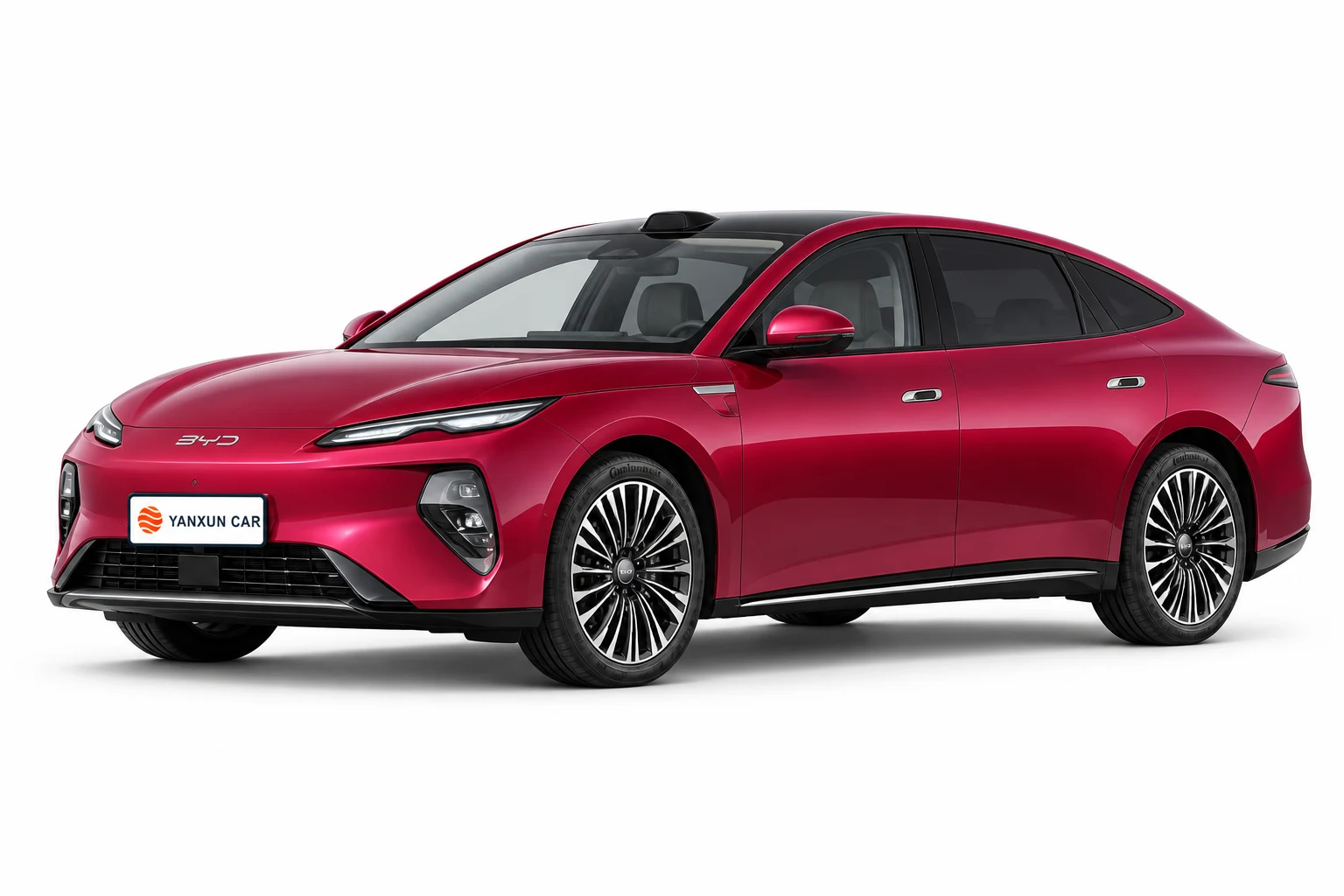
2026 BYD Seal 08 at a glance
| Vehicle type | Large five-seat fastback sedan |
|---|---|
| Powertrains | Battery-electric EV, front-wheel-drive DM-i and all-wheel-drive DM-p |
| Length × width × height | 5,150 × 1,999 × 1,505 mm |
| Wheelbase | 3,030 mm |
| EV CLTC range | 775, 785 or 905 km |
| PHEV electric CLTC range | 350 or 400 km |
| Fastest 0–100 km/h | 3.3 seconds (EV AWD); 3.8 seconds (DM-p AWD) |
| Battery | Second-generation LFP Blade Battery |
| Chassis | Front double-wishbone, rear five-link, active rear-wheel steering |
The 2026 BYD Seal 08 sits above the Seal 07 as the Ocean Series flagship sedan. It is a 5.15-metre, five-seat car offered with three EV and three plug-in-hybrid configurations. Rather than treating the electric and hybrid versions as separate products, BYD gives both the same basic body, long 3,030 mm wheelbase, native flash-charging architecture, active rear-wheel steering and LiDAR-assisted driving hardware.
Six versions and their main specifications
| Version | Drive | Battery / engine | CLTC range | System output | 0–100 km/h |
|---|---|---|---|---|---|
| EV 775KM | RWD | 76.744 kWh LFP | 775 km | 255 kW / 500 N·m | 5.2 s |
| EV 905KM | RWD | 92.093 kWh LFP | 905 km | 320 kW / 500 N·m | 4.9 s |
| EV 785KM | AWD | 92.093 kWh LFP | 785 km | 510 kW / 810 N·m | 3.3 s |
| DM-i 400KM | FWD | 45.36 kWh LFP + 1.5T | 400 km electric | 200 kW motor / 315 N·m | 6.8 s |
| DM-i 400KM Flagship | FWD | 45.36 kWh LFP + 1.5T | 400 km electric | 200 kW motor / 315 N·m | 6.8 s |
| DM-p 350KM | AWD | 45.36 kWh LFP + 1.5T | 350 km electric | 400 kW / 675 N·m | 3.8 s |
All range figures above are China-market CLTC ratings. The two front-wheel-drive hybrids quote up to 1,660 km of combined fuel-and-electric range, while the DM-p is rated at up to 1,620 km. The 1.5-litre turbocharged hybrid engine produces 115 kW and 225 N·m; propulsion is primarily electric, with the engine supporting efficiency and long-distance operation.
EV: long range or high performance
- EV 775KM: the lighter 76.744 kWh rear-drive version. Its 255 kW motor and 5.2-second acceleration already place it well above ordinary family-sedan performance.
- EV 905KM: the range-led version. A 92.093 kWh battery and 320 kW rear motor deliver the headline 905 km CLTC figure without giving up strong 4.9-second acceleration.
- EV 785KM AWD: the performance flagship. Front and rear motors produce a combined 510 kW and 810 N·m, cutting the sprint to 3.3 seconds. Its extra motor and performance calibration reduce the nominal range to 785 km.
The EV uses an 800 V electrical platform with BYD's second-generation Blade Battery and CTB battery-to-body integration. The 905KM version is the natural long-distance choice, while the AWD model is aimed at drivers who value traction and acceleration over the highest possible range number.
DM-i and DM-p plug-in hybrids
The DM-i 400KM versions use front-wheel drive and a 200 kW traction motor. Their 400 km CLTC electric rating is unusually long for a PHEV, so many daily journeys can be completed without starting the engine. When fuel and battery are both available, BYD quotes a combined range of up to 1,660 km and NEDC charge-depleted fuel consumption of 3.6 L/100 km.
The DM-p 350KM adds a rear motor for all-wheel drive. Combined motor output rises to 400 kW and 675 N·m, and 0–100 km/h falls to 3.8 seconds. The trade-off is a slightly shorter 350 km electric rating and a quoted combined range of up to 1,620 km. It is the hybrid to choose for maximum traction and performance; the front-drive DM-i is the efficiency-focused option.
Flash charging and the second-generation Blade Battery
Seal 08 is one of BYD's first model families to make native flash charging available across both EV and plug-in-hybrid versions. Under BYD's stated test conditions and with a compatible flash charger, the battery can move from 10% to 70% in about five minutes and from 10% to 97% in about nine minutes. BYD also says a charge in −30°C conditions takes only around three minutes longer.
These figures depend on battery temperature, state of charge and the charger used. On an ordinary public DC charger, charging power will follow the capabilities of that station rather than the platform's peak potential. The important engineering point is that the EV and PHEV versions share high-voltage charging hardware instead of reserving fast charging for the pure EV.
Dimensions, aerodynamics and storage
- Body: 5,150 mm long, 1,999 mm wide and 1,505 mm high.
- Wheelbase: 3,030 mm, giving the rear cabin the proportions expected of a large sedan.
- Aerodynamics: quoted drag coefficient of Cd 0.207.
- Wheels: 19-inch wheels with 245/45 R19 tyres are listed across the range.
- Front storage: the EV provides a 160-litre powered front trunk with multiple opening methods.
- Rear storage: up to 533 litres, plus 40 smaller storage locations through the cabin.
The fastback roof does not turn the Seal 08 into a two-door-style sports car: it remains a five-seat family sedan with electrically adjustable rear backrests, rear leg supports on equipped versions and a passenger-seat-back work table. Higher specifications also add dual zero-gravity front seats, heating, ventilation and massage functions.
Chassis: rear steering makes the size easier to manage
The basic suspension layout is double wishbone at the front and five-link independent suspension at the rear. Active rear-wheel steering can turn the rear wheels by up to ±7 degrees. At low speed they turn opposite to the front wheels, reducing the minimum turning radius to a quoted 4.95 metres; at higher speed they can turn in the same direction to support stability during lane changes. An intelligent crab-walk function can also move the car diagonally in constrained situations.
Premium versions use BYD's DiSus-C adaptive damping. Flagship versions upgrade to the closed dual-chamber DiSus-A air suspension, with five height settings, up to 55 mm of adjustment and a forward-looking road-preview function. This is a meaningful distinction between versions: every Seal 08 gets the useful rear-steering hardware, while the more elaborate air system belongs to the upper trim levels.
Cabin technology and comfort highlights
- Four powered soft-close doors and a segmented panoramic glass roof.
- Front zero-gravity seating on equipped versions, with broad heating, ventilation and massage coverage.
- Electrically adjustable rear backrests and leg supports, plus a fold-out table behind the front passenger seat.
- Three-zone climate control, an available heating/cooling refrigerator and double-layer acoustic glass.
- DiLink connected cockpit functions, voice control, OTA updates and a premium multi-speaker audio system.
- Useful details including a drained umbrella compartment, integrated tissue storage and magnetic accessory mounting points.
Driver assistance and passive safety
The range is listed with God's Eye B, BYD's LiDAR-equipped driver-assistance package. It supports highway and urban navigation assistance, lane centring, adaptive cruise functions and automated parking scenarios. These remain driver-assistance features: the driver must supervise the vehicle and follow local rules.
Passive safety specifications include 11 airbags and a body structure in which high-strength steel and aluminium account for a quoted 86.3%. The CTB structure also integrates the EV battery pack into the body. Exact software functions can change through OTA updates, while equipment can differ by version and production date.
Which version best fits each use case?
- Choose EV 775KM for the smaller battery, strong rear-drive performance and the core chassis and charging technology.
- Choose EV 905KM when maximum nominal electric range matters more than four-wheel drive.
- Choose EV 785KM AWD for 510 kW performance, all-weather traction and the quickest acceleration.
- Choose DM-i 400KM for long electric commuting combined with petrol-backed long-distance flexibility.
- Choose DM-p 350KM when hybrid flexibility and high-output all-wheel drive are both priorities.
Verdict
The Seal 08 is not simply a larger Seal. Its unusual combination of 905 km maximum CLTC EV range, up to 400 km of plug-in-hybrid electric range, flash charging, standard rear-wheel steering and an available dual-chamber air suspension gives it a distinct technical position. The six-version range also has a clear logic: rear-drive EV for efficiency, AWD EV for performance, DM-i for long-distance economy and DM-p for hybrid traction. For buyers comparing large Chinese electric sedans, the key decision is therefore not equipment alone, but which of these four powertrain characters best matches daily use.
Sources: BYD official Seal 08 EV and DM-i product information, BYD's 17-millionth NEV announcement, Xinhua's launch report and published China-market configuration data. Specifications may vary by trim and production batch.