
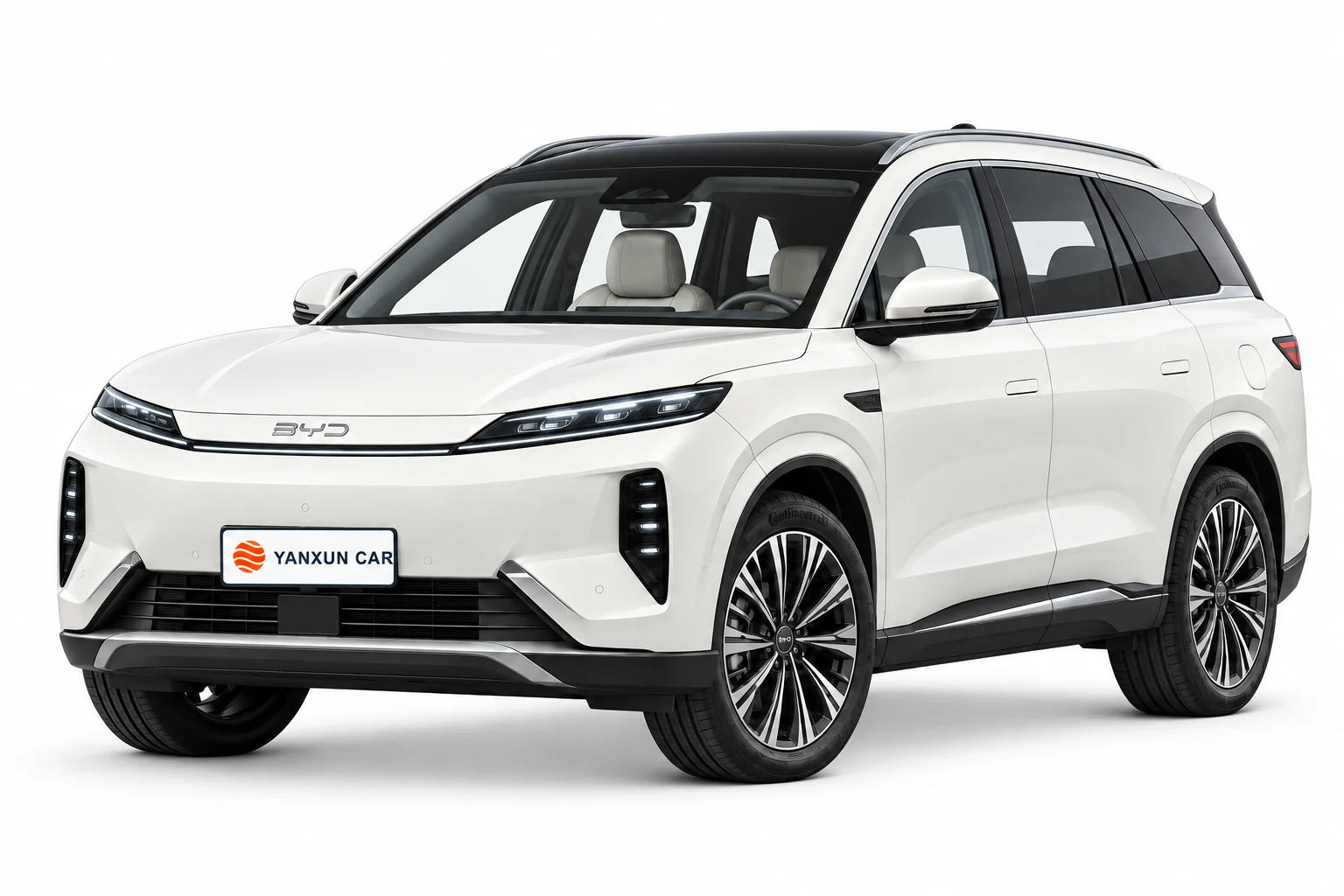
2026 BYD Song Ultra at a glance
| Vehicle type | Five-seat mid-size SUV |
|---|---|
| Powertrains | Battery-electric EV and plug-in-hybrid DM-i |
| Length × width × height | 4,850 × 1,910 × 1,670 mm |
| Wheelbase | 2,840 mm |
| EV versions | 605KM Leading, 605KM Overtaking, 710KM Overtaking, 710KM Excellence |
| DM-i versions | 205KM Leading/Overtaking; 310KM Leading/Overtaking/Excellence |
| EV motor | Rear-wheel drive, 240 or 270 kW, up to 305 N·m |
| Charging | Second-generation Blade Battery with BYD flash charging on EV |
| Chassis | Independent suspension; available DiSus-C adaptive damping |
| Seats and luggage | Five seats; EV 150 L front trunk and 730–1,659 L rear load area |
The 2026 BYD Song Ultra is the larger and more technically ambitious member of the Song family. At 4.85 metres long with a 2.84-metre wheelbase, it sits above the familiar Song Pro and offers two very different energy systems in one body: a rear-drive EV with 605 or 710 km of CLTC range, and a front-driven DM-i plug-in hybrid with 205 or 310 km of rated electric range.
Nine versions and the main differences
| Version group | Powertrain | Drive | Rated range | Main positioning |
|---|---|---|---|---|
| EV 605KM Leading | Blade Battery + 240 kW motor | RWD | 605 km CLTC | Core EV specification |
| EV 605KM Overtaking | Blade Battery + 240 kW motor | RWD | 605 km CLTC | More comfort and technology |
| EV 710KM Overtaking | Blade Battery + 270 kW motor | RWD | 710 km CLTC | Longer range and stronger motor |
| EV 710KM Excellence | Blade Battery + 270 kW motor | RWD | 710 km CLTC | Highest EV equipment level |
| DM-i 205KM Leading | 1.5 L hybrid + EHS | FWD | 205 km electric | Long electric commuting |
| DM-i 205KM Overtaking | 1.5 L hybrid + EHS | FWD | 205 km electric | Added cabin and assistance features |
| DM-i 310KM Leading | 1.5 L hybrid + EHS | FWD | 310 km electric | Largest hybrid electric range |
| DM-i 310KM Overtaking | 1.5 L hybrid + EHS | FWD | 310 km electric | Range plus upgraded equipment |
| DM-i 310KM Excellence | 1.5 L hybrid + EHS | FWD | 310 km electric | Flagship plug-in hybrid |
The trim names translated as Leading, Overtaking and Excellence describe equipment levels rather than different body styles. Exact seat functions, audio, adaptive suspension and assistance features should therefore be checked by trim; the important mechanical split is 605 versus 710 km for EV and 205 versus 310 km for DM-i.
Dimensions and exterior hardware
- Length: 4,850 mm.
- Width: 1,910 mm.
- Height: 1,670 mm.
- Wheelbase: 2,840 mm.
- Layout: five doors, five seats and a flat-folding rear bench.
- Lighting: slim full-width front signature and a Chinese-knot-inspired full-width rear lamp.
- Access: flush door handles, smartphone NFC key and hands-free methods for the powered tailgate on equipped versions.
The Song Ultra is 4.85 metres long but its short overhangs and 2.84-metre wheelbase give most of that footprint to the cabin. The Dynasty-series front graphics are restrained compared with off-road BYD products, while the near-horizontal shoulder line and broad tail make the car visually wider.
Song Ultra EV: 605 or 710 km
Both EV range groups are rear-wheel drive. The 605KM versions use a 240 kW motor; the 710KM versions increase motor output to 270 kW. Peak torque is listed at up to 305 N·m. The stronger 710KM version is therefore not merely a larger-battery derivative: it combines the headline range with the highest regular Song Ultra output.
The EV uses BYD's second-generation LFP Blade Battery and a high-voltage flash-charging system. Under BYD's stated conditions and on compatible flash-charging hardware, charging can progress from 10% to 70% in about five minutes and from 10% to 97% in about nine minutes. At −30°C, BYD says the 20–97% process takes only about three minutes longer than the normal-temperature benchmark.
Song Ultra DM-i: 205 or 310 km electric
The DM-i uses BYD's fifth-generation plug-in-hybrid architecture: a dedicated 1.5-litre petrol engine, EHS electric-hybrid system and power-type Blade Battery. It is designed to drive primarily through the electric motor, using the engine when efficiency or sustained power requires it. The result is smoother low-speed response than a conventional multi-gear hybrid.
A 205 km CLTC electric rating already covers extended daily use without fuel, while the 310 km versions push the hybrid closer to EV-style commuting. The petrol system remains available for longer travel after the usable traction-battery charge is reduced. Unlike the rear-drive EV, DM-i is front-wheel drive; this is a meaningful handling and packaging difference, not simply another battery choice.
EV flash charging in practical terms
| Battery chemistry | LFP second-generation Blade Battery |
|---|---|
| Fast-charge benchmark | 10–70% in about 5 minutes |
| Near-full benchmark | 10–97% in about 9 minutes |
| Cold benchmark | 20–97% at −30°C in approximately 12 minutes |
| Required hardware | Compatible BYD flash-charging system for peak figures |
These are peak-system results, not a promise for every DC charger. Charging voltage, station output, battery temperature and state of charge all affect the real curve. On lower-power infrastructure the Song Ultra EV still charges normally, but it cannot reproduce the five- and nine-minute figures.
Suspension, damping and stability
The Song Ultra uses independent suspension, with upper versions adding DiSus-C intelligent damping. DiSus-C can adjust damper force in milliseconds and use road-preview data to prepare for bumps. Its role is to reduce pitch under acceleration and braking, control roll in corners and isolate broken surfaces without using a full air-suspension system.
BYD also lists a TBC high-speed tyre-blowout stability system. Under defined test conditions it can coordinate steering, braking and torque to stabilise the vehicle at speeds up to 140 km/h following a sudden tyre pressure loss. It does not eliminate tyre maintenance; it is an emergency control layer.
Passenger space and seat functions
- Large five-seat cabin with a 2,840 mm wheelbase.
- Front passenger “queen seat” functions can include powered leg rest, heating, ventilation and massage.
- Ten-layer comfort seat construction is listed for selected versions.
- Rear seats fold flat enough to create an approximately 1.8 m resting surface.
- Panoramic glass roof with powered sunshade.
- Heating/cooling refrigerator integrated into the centre area on equipped versions.
The Song Ultra emphasises family utility rather than a third row. Five seats allow a broader rear bench, more generous cargo depth and a flatter sleeping arrangement. Version selection matters because massage, leg rest, ventilation and refrigerator equipment are not identical across all nine trims.
Cargo measurements
| EV front trunk | 150 litres |
|---|---|
| Rear luggage space | 730 litres |
| Rear seats folded | Up to 1,659 litres |
| Resting/bed length | Approximately 1.8 metres |
The 150-litre powered front trunk is specific to the EV packaging and is large enough for charging equipment or smaller travel bags. The 730-litre rear compartment is unusually generous for a five-seat mid-size SUV, and the 1,659-litre expanded figure is one of the Song Ultra's clearest practical advantages.
Displays, connectivity and cabin equipment
- Central display: up to 15.6 inches.
- Head-up display: 26-inch projected W-HUD on equipped versions.
- Audio: up to 16 speakers.
- Phone charging: 50 W ventilated wireless charging.
- Keys: smartphone NFC and connected remote functions.
- Controls: column-mounted electronic selector frees centre-console storage.
- Ecosystem: accessory interfaces can support child seats, pet equipment and cabin devices.
Driver assistance and passive safety
Upper Song Ultra specifications use God's Eye B, the LiDAR-equipped BYD driver-assistance package. It supports highway and urban navigation assistance, lane and speed control, parking assistance and automatic emergency braking scenarios. These are supervised assistance functions and do not remove driver responsibility.
Passive protection includes seven airbags, including a far-side centre airbag, a cage-type body, full-frame subframes and energy-management structures around the front rails. BYD also lists a driver-monitoring system and an all-direction recording function on relevant trims.
EV or DM-i?
- EV 605KM: for buyers who want the flash-charging architecture and core rear-drive layout without prioritising the largest nominal range.
- EV 710KM: for maximum electric distance and the stronger 270 kW motor.
- DM-i 205KM: for substantial electric commuting with petrol-backed flexibility.
- DM-i 310KM: for drivers who want most regular trips to feel EV-like while retaining the hybrid system.
Verdict
The Song Ultra's strongest feature is the breadth hidden under one body. EV buyers receive rear-wheel drive, 605 or 710 km CLTC range, second-generation Blade Battery technology and very high peak charging capability. DM-i buyers receive unusually long 205 or 310 km electric ratings plus a petrol system for extended use. Add the 2,840 mm wheelbase, 730-litre rear compartment, available DiSus-C and LiDAR assistance, and the result is a parameter-rich family SUV whose version differences are mechanical as well as cosmetic.
Sources: BYD official Song Ultra EV and DM-i product information, BYD flash-charging technical information and published China-market configuration data. Specifications can vary by trim and production batch.