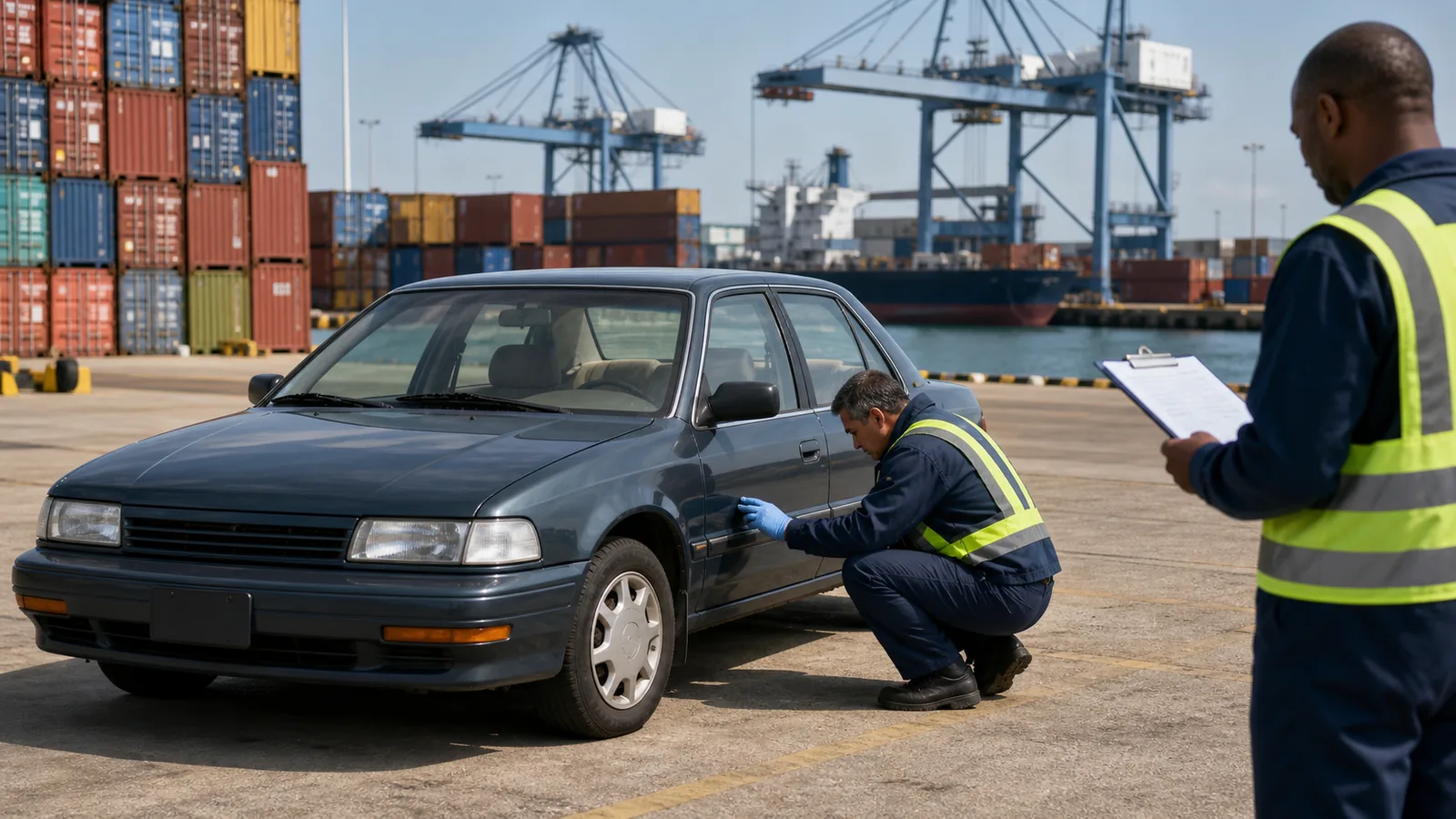
Verified 12 August 2026. Most recent China-market used cars cannot simply be shipped to the United States and registered for road use. Before paying a deposit, a buyer must separately confirm federal safety eligibility, federal emissions eligibility, customs classification and tariffs, and the registration rules of the destination state. “Used” is a commercial description, not a federal compliance exemption.
Start with the exact vehicle, not a model name
Obtain the vehicle identification number, actual manufacturing date, model year, first-registration record, current foreign title or registration, and clear photographs of the manufacturer certification labels. Ask for the original Chinese model name and exact powertrain, because similar badges can identify materially different batteries, engines, software or safety equipment. Do not book freight on the assumption that a listing year proves the vehicle’s age or eligibility.
Also decide the intended use. Permanent road registration, temporary display, racing, research and controlled testing follow different routes. This guide addresses ordinary permanent importation for road use; a specialist should assess any narrow exception before shipment.
NHTSA safety eligibility: understand the 25-year rule
A vehicle originally manufactured to comply with all applicable Federal Motor Vehicle Safety Standards normally carries a certification label. A foreign-market vehicle without that label is not automatically eligible merely because it is second-hand. NHTSA treats a vehicle at least 25 years old, measured from its actual manufacturing date, as outside the FMVSS compliance requirement for importation. The importer ordinarily declares that route on DOT Form HS-7, Box 1.
If the manufacturing date cannot be established from a label, retain reliable evidence such as the first sales invoice, historical registration documents or a recognized vehicle-history record. Model year alone can be too imprecise near the 25-year threshold.
For a vehicle under 25 years old without original U.S. certification, the difficult route is a NHTSA import-eligibility determination followed by importation through a Registered Importer. A similar U.S.-certified model may help, but similarity must be accepted through the formal process. The RI route can require a DOT conformance bond equal to 150% of the vehicle’s declared value and completion of conformity work within the applicable 120-day period. A buyer should obtain a written RI assessment and complete cost estimate before purchase.
EPA emissions eligibility uses a different age test
EPA’s age exemption is not the same as NHTSA’s. A vehicle may qualify under EPA Code E when it is at least 21 original production years old and remains in its original, unmodified configuration. EPA generally calculates this age by subtracting the manufacturing year from the calendar year of importation. Engine replacement or material powertrain modification can defeat the route unless the replacement meets the relevant EPA conditions.
This creates a practical gap: a 21-to-24-year-old vehicle may satisfy the EPA age provision but still fail the NHTSA 25-year safety exemption. When no EPA exemption or U.S. emissions certification applies, an Independent Commercial Importer may need to modify, test and certify the vehicle. An ICI is separate from a NHTSA Registered Importer. A vehicle can require both, and finding either only after arrival can leave the importer with storage, export or destruction costs.
Build the customs file before the car leaves China
A customs broker should confirm the entry plan and Harmonized Tariff Schedule classification before shipment. The working file commonly includes:
- the original bill of lading;
- the purchase contract and commercial invoice;
- foreign title or registration and proof of ownership;
- DOT Form HS-7 and EPA Form 3520-1;
- the RI contract, eligibility evidence and conformance bond when applicable; and
- any state-specific evidence already identified for later titling.
Clean the undercarriage thoroughly to reduce agricultural inspection risk, and do not use the vehicle as a container for undeclared goods. After entry, retain the CBP entry record, including Form 7501 where issued, together with every federal compliance document. A customs release is important evidence, but it is not a promise that a state motor-vehicle agency will issue a title.
Estimate tariffs separately from legal admissibility
Paying duty does not cure an ineligible vehicle. As of the verification date, a typical passenger vehicle may begin with a 2.5% normal customs rate. Many imported automobiles have also been subject to a 25% Section 232 automobile tariff since 3 April 2025. Relevant China-origin internal-combustion and non-plug-in hybrid classifications may carry an additional 25% Section 301 duty, while relevant China-origin battery-electric and plug-in-hybrid classifications may carry a 100% Section 301 rate.
Those layers can produce an illustrative 52.5% total for some China-origin conventional passenger cars or 127.5% for some China-origin EV or plug-in classifications. They are not universal quotations. Classification, customs value, origin, exclusions and effective dates control the actual amount. The 2025 IEEPA China surcharge was ended on 20 February 2026, and the July 2026 forced-labor Section 301 action described an exclusion for automobiles already covered by Section 232; neither should be added mechanically to an automobile estimate.
Origin is not the same as shipping location. Routing a Chinese-made car through a third country does not normally change its origin, while a non-Chinese-origin vehicle purchased in China should not automatically receive a China-origin tariff calculation. Ask a licensed customs broker for a written, vehicle-specific estimate using the current HTS.
Check connected-vehicle restrictions and state registration
For newer connected vehicles under 10,001 pounds, the BIS connected-vehicles rule creates another independent review. Restrictions involving certain China- or Russia-related vehicle connectivity system and automated-driving software begin with model year 2027, with covered hardware provisions expanding for model year 2030. Recent China-market vehicles therefore need a BIS analysis even if another federal route appears available.
Finally, confirm the destination state before buying. States can require inspection, insurance, odometer evidence, taxes, emissions documentation and other title records. California can require additional direct-import and emissions evidence, including California Air Resources Board-related compliance, and some vehicles that clear federal customs may still be impractical or impossible to register there.
A safer order of operations
- Identify the exact vehicle and document its manufacturing date, VIN and labels.
- Obtain written NHTSA and EPA pathway assessments; engage an RI or ICI before shipment if needed.
- Ask the destination-state DMV, in writing where possible, what it will require for title and registration.
- Have a customs broker classify the vehicle and estimate all current duties and fees.
- Compare the compliance, tariff, inland transport, port, freight, insurance and state costs with the vehicle’s landed value.
- Only then finalize the purchase, inspection scope and shipping booking.
Yanxun Car can provide vehicle-level sourcing information and export documentation available in China. Buyers should use a pre-order eligibility review to request the VIN, manufacturing date, label photographs and destination details before committing funds.
Important limitation
This article is general commercial information, not legal, customs, tax, emissions or state-registration advice. Rules and tariff measures can change, and an agency or licensed professional must determine the outcome for the exact vehicle and entry date. No statement here guarantees import approval, customs release, road registration or a particular duty rate.
Sources
- NHTSA: Importation and Certification FAQs
- NHTSA: Declaration Form HS-7
- NHTSA: Registered Importers
- EPA: Learn About Importing Vehicles and Engines
- EPA: Form 3520-1
- CBP: Importing a Motor Vehicle
- CBP: Documents for Registering an Imported Vehicle
- California DMV: Register an Imported Vehicle
- White House: Adjusting Imports of Automobiles and Automobile Parts
- USTR: Final Section 301 Modifications Published September 2024
- USITC: Current Harmonized Tariff Schedule
- White House: Ending Certain Tariff Actions
- USTR: July 2026 Section 301 Forced-Labor Action Fact Sheet
- BIS: Connected Vehicles Rule