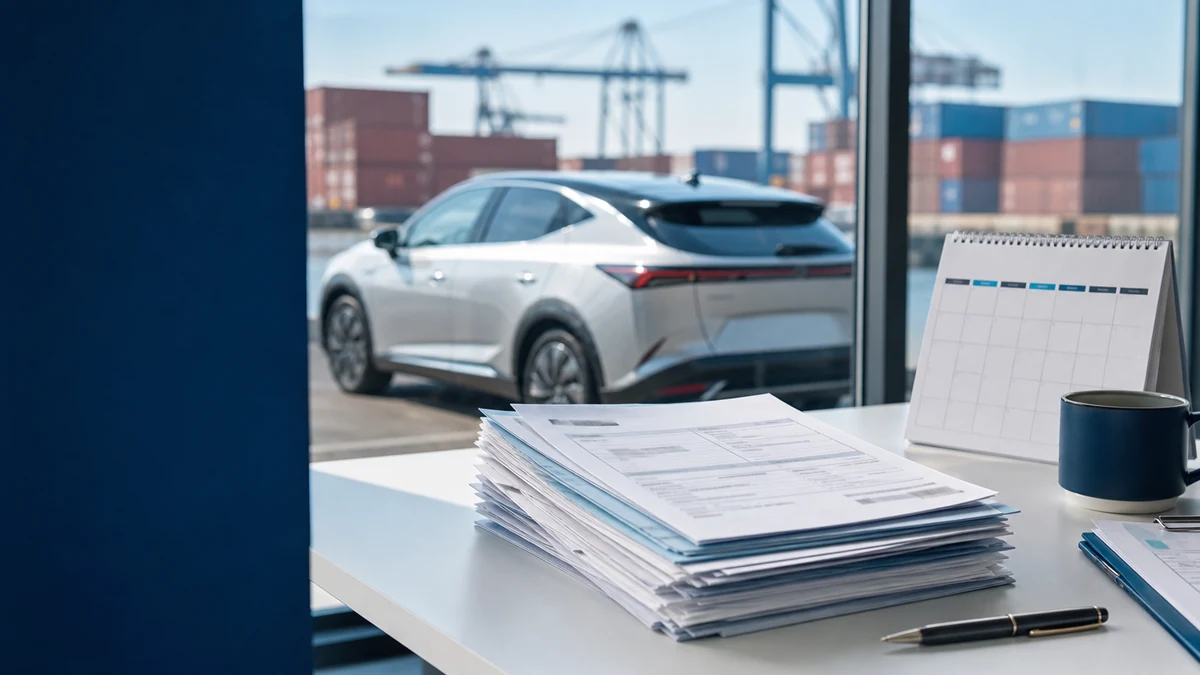
Updated 1 August 2026. China’s 2026 export-licence framework for certain pure-electric passenger vehicles is now in effect. The change is important for international buyers because it adds a document-and-classification question before a shipment is booked. It does not, by itself, prove vehicle condition, destination-market approval or a seller’s performance on a particular order.
What changed on 1 January 2026
MOFCOM Announcement No. 54 of 2025, issued by the Ministry of Commerce, Ministry of Industry and Information Technology, General Administration of Customs and State Administration for Market Regulation, brought export-licence management into effect on 1 January 2026 for specified pure-electric passenger vehicles.
The notice describes the covered goods as other passenger vehicles equipped only with an electric drive motor and carrying a VIN, with customs code 8703801090 given as a reference. The scope should not be casually extended to plug-in hybrids, conventional petrol vehicles or every vehicle marketed as “new energy”. Classification depends on the actual vehicle and transaction facts.
What the licence framework does — and does not — prove
A licence framework is not a substitute for a purchase inspection. It does not prove that a used vehicle has no accident history, that its battery meets a buyer’s preferred threshold, or that the vehicle will be eligible for registration in the destination market. Conversely, a vehicle’s marketplace listing is not proof that the required export process applies or has been completed.
For 2026 applications, MOFCOM states that businesses intending to export covered pure-electric passenger vehicles must apply as “passenger vehicles” in the online system, and that the Ministry may verify the authenticity of application materials. The original 2026 application notice is the correct starting point for the administrative context.
A buyer’s four-point verification list
- Identify the exporter. Ask the contracting exporter to state its role in the transaction and to provide the shipment-specific documents that it is permitted to share.
- Match the VIN. The VIN should align across the sales contract, invoice, registration material, transport documents and the exporter’s declared vehicle information.
- Confirm classification. Ask the exporter or customs professional to explain whether the exact vehicle falls within the cited pure-electric passenger-vehicle scope. Do not infer this from a badge, range figure or marketing label.
- Check the destination separately. Import approval, registration, steering position, charging compatibility, taxes and local standards remain destination-market questions.
Why the eligible-enterprise list is context, not a shipment guarantee
MOFCOM, MIIT and SAMR published the 2026 list of enterprises eligible to apply for automobile export licences. That publication is useful background when assessing an exporter’s credentials, but it should not be presented as proof that a particular vehicle, route or shipment has been approved. A buyer should still reconcile the individual vehicle and shipping documents.
Practical procurement note
For a clean B2B file, capture the model, VIN, powertrain, first-registration date, source location, agreed condition report and destination port before requesting a quotation. You can use our vehicle catalogue to shortlist stock, then confirm final specification, export documentation and destination-market requirements with the export team before payment or shipment.
Sources and method
This is an original buyer brief based on the linked official MOFCOM notices and enterprise-list publication. It is not legal, customs or tax advice. Export classification, licence requirements and destination-market rules should be confirmed for the individual vehicle and shipment.