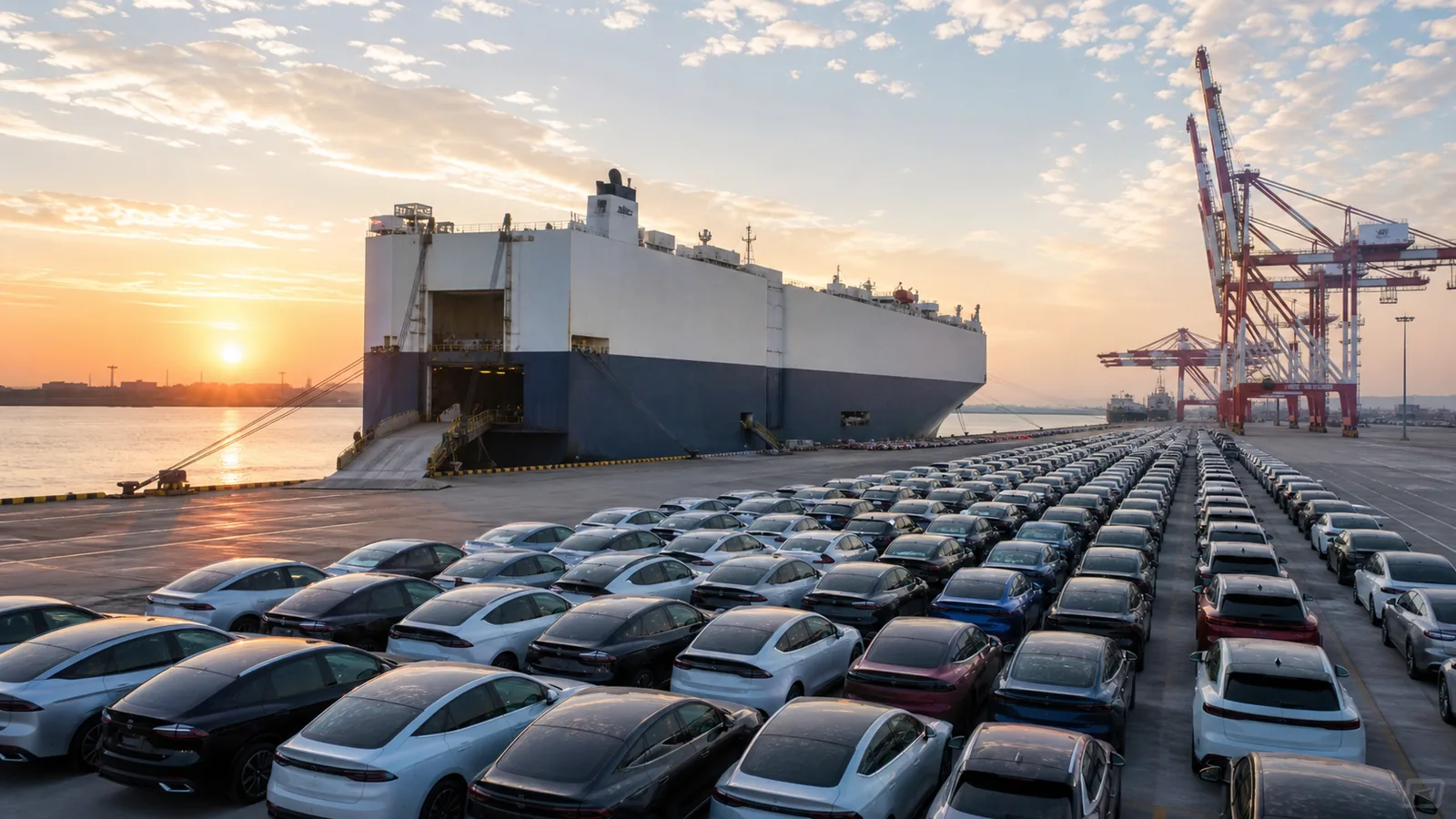
Verified 12 August 2026. China’s electric-car exports increased 68.7% year on year in the first half of 2026, according to an official customs briefing. The figure points to a rapidly expanding export ecosystem and a wider international conversation about Chinese vehicles. It does not, by itself, prove the availability, condition, destination eligibility or landed cost of any individual used car.
The official first-half snapshot
| Measure | Official figure | Period |
|---|---|---|
| Electric-car export growth | 68.7% year on year | January–June 2026 |
| China’s total goods trade | RMB 25.47 trillion, up 16.9% | January–June 2026 |
| Trade with Belt and Road partner countries | Up 14.8%; 50.9% of total trade | January–June 2026 |
| Total automobile exports | 5.096 million vehicles | January–June 2026 |
| New-energy vehicle exports | 2.355 million vehicles | January–June 2026 |
The General Administration of Customs briefing also reported that trade with neighboring countries grew 20.6%, trade with Latin America grew 16.2%, and trade with Africa grew 19.6%. A separate central-government statistics release reported 5.096 million automobile exports in the first half, including 2.355 million new-energy vehicles.
These official indicators describe related but different datasets. A percentage increase in customs-reported electric-car exports should not be treated as the unit count for every new-energy vehicle category, and an industry-wide export total should not be presented as a company’s sales performance. The defensible conclusion is that vehicle exports and the supporting trade network expanded strongly during the period.
Why scale can help an overseas buyer
A larger export market can support more experienced inspection providers, inland carriers, port operators, documentation specialists and shipping services. It can also expose buyers to a broader selection of battery-electric vehicles, plug-in hybrids, conventional hybrids and petrol models. More choice is useful when a buyer has a defined operating requirement rather than a general request for the lowest price.
Scale also increases the need for precise identification. Chinese manufacturers can offer several battery packs, motor outputs, range ratings, charging inlets and software configurations under closely related model names. Export growth does not make those variants interchangeable. The original Chinese model name, VIN, manufacturing date and configuration evidence remain essential.
The fastest-growing product is not automatically the right product
A battery-electric vehicle may be attractive where electricity is reliable, compatible charging is available and the expected route fits the vehicle’s practical range. A plug-in hybrid may suit a market that can charge regularly but still needs long-distance fuel flexibility. A petrol vehicle may remain preferable where charging coverage, repair capability or spare-parts access is limited. The national export trend cannot answer that local operating question.
Before choosing a powertrain, buyers should compare:
- the destination’s AC and DC connector standards and grid conditions;
- daily distance, climate, terrain and payload;
- traction-battery chemistry, capacity, diagnostic evidence and thermal management;
- fuel quality, emissions rules and inspection requirements for combustion vehicles;
- availability of service information, trained technicians and critical spare parts; and
- the complete landed cost, including compliance, tariffs, freight, insurance and local taxes.
What the regional trade figures do—and do not—show
Growth in trade with neighboring markets, Latin America and Africa is commercially relevant because it indicates broader cross-border activity. It does not show that vehicle demand grew at exactly the same rate in each region, that every destination accepts the same specification, or that every shipping route has equal capacity. Nor does it prove that a particular model can be registered or supported after arrival.
Central Asian importers may prioritize winter range, ground clearance and overland logistics. Buyers in parts of Africa may emphasize heat management, road conditions, parts availability and port-to-inland transport. Latin American requirements vary by country on homologation, connector type, taxes and steering position. A sales proposal should therefore translate a macro trend into destination-specific questions instead of repeating the headline percentage.
A practical vehicle-level verification file
For each candidate car, keep one record containing the source listing, VIN or agreed protected identifier, manufacturing date, first-registration date, mileage, condition disclosure, inspection evidence and current location. For an EV, add the exact battery and charging specification, the stated range test standard and any available diagnostic report. For every powertrain, record the steering position, dimensions, curb weight, software language and included equipment.
The commercial side should be equally explicit. A comparable quotation names the Incoterms rule, handover point or port, destination, currency, validity period and included charges. It separates the vehicle price from inland movement, export handling, sea or land freight, insurance and destination costs. A broad export-growth statistic cannot replace any of those fields.
Questions buyers should ask before confirming an order
- Is this exact vehicle in stock, and can its identity and location be verified?
- Which model, trim, battery or engine configuration does the VIN support?
- What condition inspection and accident-history evidence is available?
- Does the destination permit this vehicle, powertrain and manufacturing year?
- Are its charging, emissions, safety and software specifications usable locally?
- Which export, transport and destination charges are included in the quote?
- What parts, technical information and after-sales support can realistically be supplied?
Sales takeaway
The 68.7% growth figure is evidence of momentum, not a promise of a cheap or easy transaction. Professional sourcing converts market scale into a documented vehicle choice: the right configuration, verified condition, a workable route and a quotation built for the destination. Buyers can review current options in the used-car catalog and send their model, quantity and destination through Request a Quote.
Important limitation
This article summarizes official aggregate data and provides general commercial interpretation. It is not a forecast, a guarantee of inventory or pricing, or legal, customs, tax, registration, battery-health or shipping advice. The cited growth rates are not Yanxun Car sales figures. Buyers must verify the exact vehicle and current destination requirements before contracting.
Sources