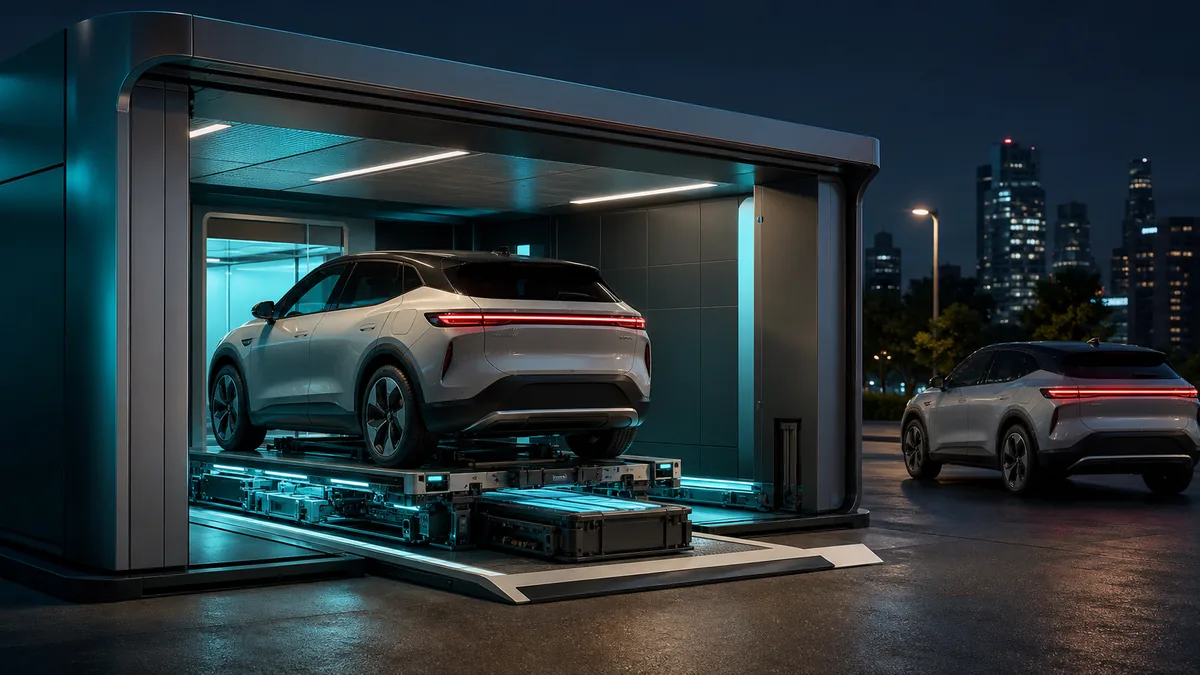
NIO's battery-swap system replaces a vehicle's traction battery at a Power Swap Station instead of waiting for the pack to recharge. It is one of the clearest examples of how EV infrastructure, battery ownership and customer service can be designed as one operating model.
For used-EV export buyers, it is useful to understand the network - but it is equally important not to assume that a China-market swap or subscription benefit transfers automatically to another country.
How NIO battery swapping works
A compatible vehicle enters a NIO Power Swap Station, where the station removes the fitted battery and installs another pack. NIO said in February 2026 that its Power Swap service averages about three minutes. The company also said that station operations centrally manage and monitor batteries, making each swap an opportunity for a battery health check and enabling grid load shifting.
Battery swapping changes the usual EV ownership equation. The driver can obtain energy quickly, while the battery fleet can be monitored, charged and managed as a network rather than only as a single vehicle asset.
Network scale: use dated figures, not a vague "national total"
On February 6, 2026, NIO said it had deployed 3,790 Power Swap Stations worldwide, including 1,020 stations along major highways in China. A later China-only snapshot published by NIO's verified account on July 10, 2026 reported 3,967 swap stations in China, alongside 5,105 charging stations and 29,383 chargers.
These counts have different dates and scopes. The July figure is China-only and later; the February figure is worldwide. They should not be compared as though they were the same monthly report.
Monthly additions: the transparent way to read the rollout
NIO does not publish a single fixed official monthly construction KPI. To avoid presenting an invented calendar-month total, the table below converts public, dated China station snapshots into a rolling 30-day pace. It is a Yanxun Car calculation, not an official NIO monthly installation report and not a forecast.
| Snapshot date | China swap stations reported | Change from previous snapshot | Approximate 30-day pace |
|---|---|---|---|
| 2026-04-15 | 3,794 | Baseline | Not calculated |
| 2026-05-17 | 3,849 | +55 in 32 days | About 52 stations per 30 days |
| 2026-06-22 | 3,923 | +74 in 36 days | About 62 stations per 30 days |
| 2026-07-10 | 3,967 | +44 in 18 days | About 73 stations per 30 days |
The public snapshots behind the calculation are available from April 15, May 17, June 22, and NIO's verified account for July 10. A change in reporting scope, station definitions or publication timing can alter the apparent pace.
What Battery as a Service (BaaS) changes
Under NIO's Battery as a Service model, the vehicle and battery can be priced separately. Rather than paying the full battery cost in the vehicle purchase price, a customer may use a battery through a continuing battery-service arrangement. NIO describes BaaS together with flexible battery upgrades and its wider NIO Power service ecosystem.
The commercial effect is straightforward: it can reduce the initial vehicle purchase price and create an ongoing relationship around battery access, account services, network availability and upgrades. It is better described as service retention than as permanent technical lock-in. Benefits, fees, battery capacity options and eligibility vary by market, vehicle, promotion and contract.
One China-market NIO example illustrates the principle: when it released the 2026 ES8 five-seat model, NIO quoted RMB 382,800 for the vehicle purchase price and RMB 274,800 as the BaaS purchase price. This example is dated, model-specific and not an export price or a universal saving.
What overseas used-EV buyers should verify
- Battery ownership: Is the battery owned with the vehicle, subscribed through BaaS, leased or subject to a separate asset arrangement?
- Transferability: Can any subscription, account right or battery-service agreement be transferred to the next owner and used outside China?
- Destination infrastructure: Is there a compatible NIO Power Swap network at the destination? If not, plan the vehicle as a plug-in EV.
- Charging compatibility: Check connector, AC/DC charging hardware, software region and local charging-network access.
- Vehicle condition: Verify VIN, first registration, battery health information, repair history and export eligibility independently.
Why this model matters to fleet and wholesale buyers
For fleets, the attraction is predictable turnaround time and a managed energy network. For an exporter, the relevance is more practical: a NIO vehicle's battery and service status can affect ownership documentation, resale value, customer expectations and destination suitability. The vehicle may remain a strong product even where swapping is unavailable, but the sales description should focus on the actual charging and ownership rights delivered with that specific unit.
Primary references
- NIO: 100 million battery swaps and station network update, February 2026
- NIO annual-report material on BaaS and service model
- NIO: 2026 ES8 China-market BaaS pricing example
Editorial note: station counts, BaaS terms, vehicle software and service eligibility change over time. Confirm all current terms with NIO or the relevant service provider before purchasing, exporting or marketing a vehicle.