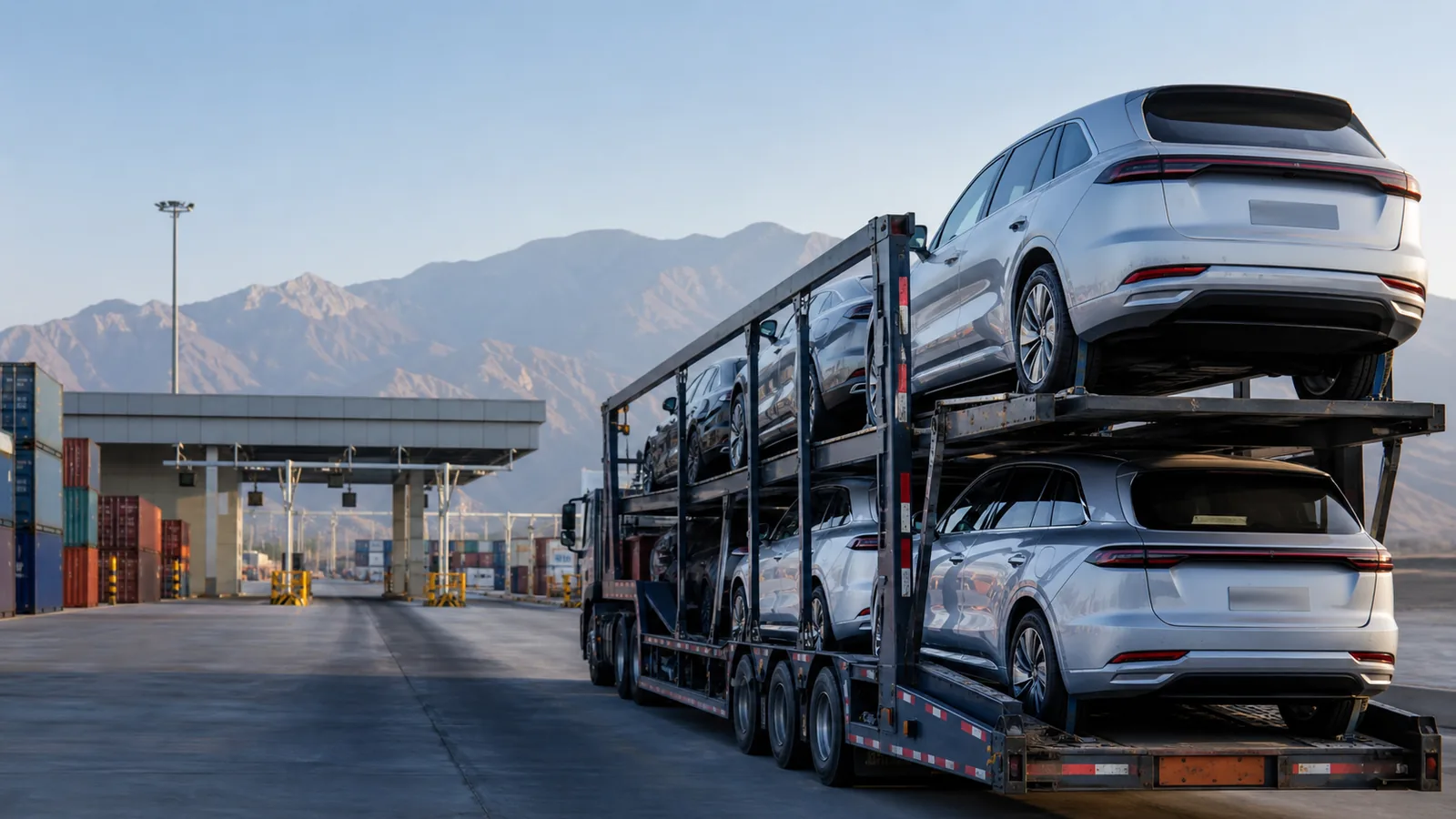
Importing a used car from China to Tajikistan is possible, but it should be treated as a regulated export and customs project rather than a simple online purchase. The buyer must confirm that the exact VIN can leave China, enter Tajikistan and be registered after arrival.
This guide reflects official rules checked through 12 August 2026. Confirmed requirements are stated as facts. Matters that could not be established precisely from accessible current official sources are listed separately and should be confirmed in writing before payment.
1. Check whether the vehicle is eligible
Tajikistan Government Resolution No. 355 of 2 August 2023 prohibits vehicles manufactured before 2013 under HS headings 8702, 8703, 8704 and 8705. This is a fixed manufacturing-year cutoff, not a rolling rule limiting every import to cars less than three years old.
A vehicle manufactured in 2013 or later is outside the literal pre-2013 prohibition. Nevertheless, ask a Tajik customs broker to confirm eligibility from the VIN and actual manufacture date. Model year, advertisement year and first-registration date can differ.
Right-hand-drive cars
Tajikistan officially uses right-hand traffic. No accessible current official source was found that conclusively allows or prohibits registration of every right-hand-drive vehicle. Treat this as unconfirmed and obtain written VIN-specific confirmation from Tajik Customs and the GAI before purchase.
2. Buy through an approved Chinese exporter
China controls used-car exports through an export-licensing system. Use a Chinese company currently approved to conduct used-car export business. Approval is valid for a limited period and participating companies must reapply annually, so request evidence of current eligibility rather than relying on an old certificate.
The approved exporter normally acquires the vehicle, completes transfer-pending-export registration, arranges inspection, applies for the licence and files the Chinese export declaration. Under the official rule, the company that exports must apply in its own name.
3. Complete the Chinese export steps
- Verify the VIN and condition. Match the body VIN with the registration certificate, contract, invoice and inspection report. Check mileage, repair and accident history, ownership and legal restrictions.
- Sign the export contract. The contract must be legally valid and include after-sales provisions. A foreign-language contract requires a Chinese translation for the licence application, with the Chinese version governing that application.
- Transfer the car for export. The exporter completes transfer-pending-export registration. Its temporary plate may be valid for no more than 60 days.
- Obtain inspection. A third-party report is required under WM/T 8-2022 for used passenger cars or WM/T 9-2022 for commercial vehicles and trailers.
- Apply for the export licence. For a complete compliant application, the provincial commerce authority has a three-working-day licence-issuance period. This is not the total delivery time.
- Declare and ship. Chinese Customs verifies the licence electronically. After clearance, the exporter must apply to cancel the Chinese registration within two months.
China prohibits export of vehicles that are scrapped or close to mandatory scrapping, mortgaged or pledged, under customs supervision, seized, stolen, fraudulently obtained, illegally assembled, inconsistent with their registration record, missing legal documents, inspection-failed, or subject to unresolved traffic violations or accidents.
4. Apply the 180-day rule
From 1 January 2026, a vehicle whose Chinese registration date is 180 days old or less needs an After-sales Repair Service Confirmation issued and stamped by the manufacturer. It must identify the destination country, vehicle and after-sales outlets. Without it, the export licence will not be issued. For a recently registered car, make delivery of this manufacturer document a condition of payment.
5. Assemble the document package
Before shipment, the buyer should receive and verify:
- the VIN-specific sales and export contract with after-sales terms;
- commercial invoice and vehicle or packing list;
- Chinese Motor Vehicle Registration Certificate or relevant export copy;
- Chinese used-car export licence;
- WM/T 8-2022 or WM/T 9-2022 inspection report;
- Chinese export customs declaration;
- CMR road consignment note or applicable rail or multimodal document;
- cargo insurance certificate;
- the manufacturer confirmation when the 180-day rule applies;
- a certificate of origin if requested by the Tajik authority or broker.
The Tajik Trade Portal’s road-vehicle procedure also lists the importer’s passport, vehicle technical document, power of attorney when an agent acts, contract, invoice, customs inspection act, customs-value declaration, document inventory, payment receipt and stamped import declaration. Business importers may need state-registration documents, a registry extract and taxpayer number.
Required translations, notarisation, originals and copy quantities could not be confirmed uniformly. Obtain a written checklist from the receiving customs post or broker before dispatch.
6. Choose the route
The direct land option is an approved vehicle carrier through Xinjiang and the Karasu–Kulma crossing. The bilateral agreement classifies it as an international road passenger and freight port open to people, vehicles and goods from both countries and third countries.
Although classified as year-round, its actual annual and daily hours may be adjusted for local conditions and weather. The treaty provides for closure on official holidays and ordinary Monday-to-Friday operation. Confirm the current schedule, carrier permit and terminal booking.
Tajikistan is landlocked and about 93% mountainous. The China–Tajik road from Dushanbe toward Kulma is approximately 1,023 kilometres, so weather, altitude, road interruptions and storage can affect delivery.
A China–Tajikistan multimodal pilot container train reached Dushanbe in February 2026 through Kyrgyzstan and Uzbekistan. The official pilot carried consumer goods and engineering equipment, not a confirmed regular passenger-car service. Use it only if the operator accepts vehicles and, for an EV, its traction battery.
7. Budget for Tajik customs taxes
For a normal taxable import in 2026, the standard import VAT rate is 14%. The current Tax Code says the VAT base includes customs value plus import taxes, customs duties, special payments and fees, excluding VAT. The rate is scheduled to become 13% on 1 January 2027.
The current official excise schedule for HS 8703 passenger vehicles states 10%, but not less than EUR 0.15 for each cubic centimetre of engine displacement. Do not turn this wording into a guaranteed quote without customs review. The exact HS code, taxable base, valuation, propulsion treatment and application of the minimum must be confirmed for the vehicle.
The exact 2026 import-duty rate for a Chinese used passenger car could not be verified from the accessible current tariff appendix. The current tariff instrument is Government Resolution No. 470 of 28 August 2024, as amended. The official Trade Portal’s calculator still shows an obsolete 18% VAT rate and cites the repealed 2018 tariff resolution, so it is not a reliable final quotation.
Before paying, obtain a written VIN- and HS-based calculation showing accepted customs value, duty, excise, VAT, customs fees, terminal charges and broker fees. Customs may review the declared value, so a deliberately low invoice can cause delay rather than a legitimate saving.
Electric-vehicle relief is narrower than it appears
Vehicles driven solely by an electric motor have an official customs-duty exemption. VAT relief is narrower: the current Tax Code exempts a pure EV only when its manufacture date is no more than one year old. An older used EV may therefore be duty-exempt but still owe VAT. Confirm its excise treatment separately and do not advertise a used EV as completely tax-free without a written calculation.
8. Clear, register and insure the vehicle
At arrival, the importer or broker completes inspection, customs-value declaration, import declaration and payment, then collects the stamped declaration and vehicle customs document before leaving the terminal.
Tajik road law normally requires state registration and technical-condition inspection within ten days of acquisition or receipt, with an exception for dealer stock intended for sale. Take the customs and ownership documents to the relevant GAI office for inspection, registration certificate and plates.
Owner civil-liability insurance is compulsory. Tajik law prohibits use of a vehicle whose owner’s liability is not covered, so arrange insurance before road use.
9. Obtain written confirmation for unresolved items
- the exact import-duty rate for the full HS code;
- final customs valuation and excise calculation;
- right-hand-drive import and registration eligibility;
- current inspection, registration, plate, terminal and storage fees;
- translation, notarisation and original-document requirements;
- current Karasu–Kulma hours and carrier permits;
- multimodal acceptance of passenger cars and traction batteries.
10. Protect the purchase
Put the VIN, manufacture and registration dates, mileage, known defects, accident disclosure, keys, charging equipment, Incoterm, document list and delivery point in the contract. Include a refund or replacement remedy if export licensing fails or inaccurate seller information prevents Tajik import or registration. Pay only to the contracting exporter’s verified corporate account, record the VIN and condition at handover, and insure inland transport, border handling and transshipment.
The safest purchase has three written confirmations before money moves: the Chinese exporter can export the exact VIN, a Tajik broker has classified and costed it, and the GAI can register it.
Sources
- China Ministry of Commerce: 2024 used-car export rules
- China Ministry of Commerce: 180-day rule effective in 2026
- Tajikistan Government Resolution No. 355 on the pre-2013 import ban
- Tajikistan National Center of Legislation: current Tax Code
- ADLIA: Government Resolution No. 335 on excise rates
- ADLIA: current import-tariff Resolution No. 470
- Tajikistan Trade Portal: road vehicle import procedure
- Tajikistan National Center of Legislation: Road Traffic Law
- Tajikistan National Center of Legislation: compulsory motor-liability insurance law
- ADLIA: Tajikistan Road Traffic Rules
- China–Tajikistan agreement governing Karasu–Kulma
- China Ministry of Foreign Affairs: Tajikistan transport information
- Chinese Embassy in Tajikistan: 2026 multimodal pilot train
- Tajikistan National Center of Legislation: pure-EV customs-duty exemption