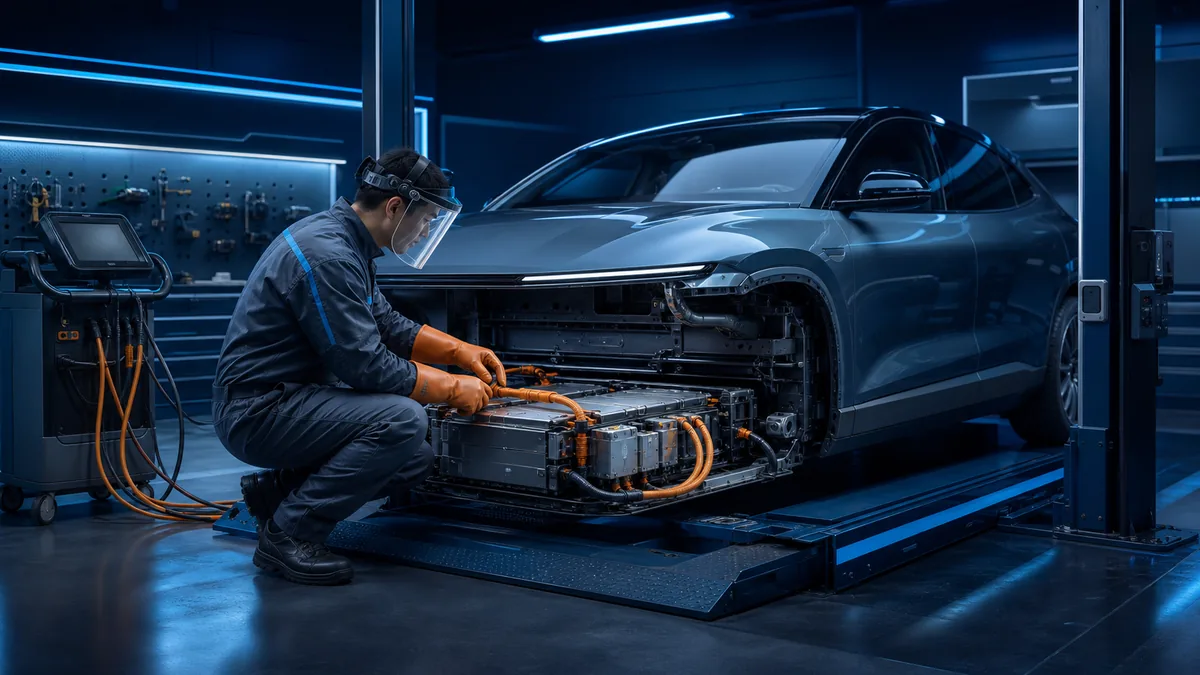
Information checked as of 9 August 2026. On 1 August 2026, China’s GB/T 47439-2026 on safety requirements for new-energy-vehicle maintenance operations took effect. The standard concerns how repair work is carried out. It should not be confused with a design-safety rule for a new battery, a battery-durability test or an export licence requirement.
What took effect
GB/T 47439-2026 was issued on 30 April 2026. On 20 July, the State Administration for Market Regulation announced its 1 August implementation and summarized its coverage: personnel and premises, preparation before work, risk identification and handling, work processes and operational safety. The official notice highlights high-voltage systems, Class B voltage circuits and hydrogen-supply systems in fuel-cell vehicles.
The “GB/T” designation is important. This is a recommended national standard, not a mandatory GB standard. Its implementation provides a recognized technical reference for safer and more consistent workshop operations, but it does not automatically certify a workshop, a repair or a used vehicle. A seller should not market a car as “government safety certified” merely because a workshop says it followed the standard.
GB/T 44510-2024, effective since 1 January 2025, addresses technical requirements for NEV maintenance and repair. The Ministry of Transport has also published the recommended industry standard JT/T 1548-2025 on after-sales maintenance service capability. Together, these references show a developing framework for workshop work and capability; they are not substitutes for vehicle-specific evidence.
Why an export buyer should care
A high-voltage repair can affect value, reliability and the inspection scope required before purchase. The useful commercial question is not whether the model is generally safe, but whether this particular vehicle had work on its battery, electric drive, charging system or high-voltage wiring, and whether the available records identify what was done.
The new standard also should not be applied backwards as a blanket claim. A repair completed before 1 August 2026 is not proven compliant simply because the vehicle is sold after that date. Conversely, the absence of a standard reference on an older invoice does not by itself prove poor workmanship. The evidence and condition must be reviewed.
Used-car repair-record checklist
- Define the repair: obtain the date, odometer reading, complaint, diagnosis, parts replaced and work performed. “Electrical repair” is too vague for a high-value transaction.
- Identify the provider: retain the workshop’s name and contact details and ask what NEV and high-voltage capability applied to the work.
- Separate systems: record whether the work involved the traction battery, modules, BMS, charging inlet, on-board charger, inverter, motor, high-voltage harness or only the 12-volt system.
- Ask for completion evidence: request the available post-repair diagnostic output, fault-code record, test result or invoice statement. Do not infer a passed test that is not documented.
- Trace replaced components: record part numbers or battery identifiers where available, plus whether components were new, remanufactured, repaired or taken from another vehicle.
- Check triggering events: request disclosure of collision, underbody impact, water exposure, fire or thermal warning, improper charging and recall work.
- Inspect the current vehicle: use a qualified independent inspector when the history, visible condition or purchase value warrants it. A historical invoice is not a current-condition report.
- Preserve uncertainty: if a record cannot be verified, state that limitation in the transaction file instead of upgrading it into a positive claim.
How to describe the vehicle accurately
A defensible listing says, for example, “High-voltage battery module replacement recorded on the workshop invoice dated [date]; current independent battery assessment not included.” It should not say “battery fully safe,” “repair approved for all markets” or “compliant worldwide.” Those statements exceed what a repair record can establish.
Buyers should also distinguish service capability in China from support in the destination country. Diagnostic access, software services, replacement parts, charging hardware and warranty treatment may differ by market and exact variant. Confirm the destination service plan before ordering a fleet.
Limits and disclaimer
GB/T 47439-2026 governs a technical subject within China’s standards system. It does not determine customs admissibility, road registration, insurance acceptance, maritime transport or local workshop law in the destination country. Those checks remain transaction- and destination-specific.
This original article is a B2B due-diligence guide, not a repair procedure and not legal, engineering or occupational-safety advice. Only qualified personnel should inspect or work on high-voltage or hydrogen systems. No article or document review can guarantee the condition or safety of a used vehicle.
Sources