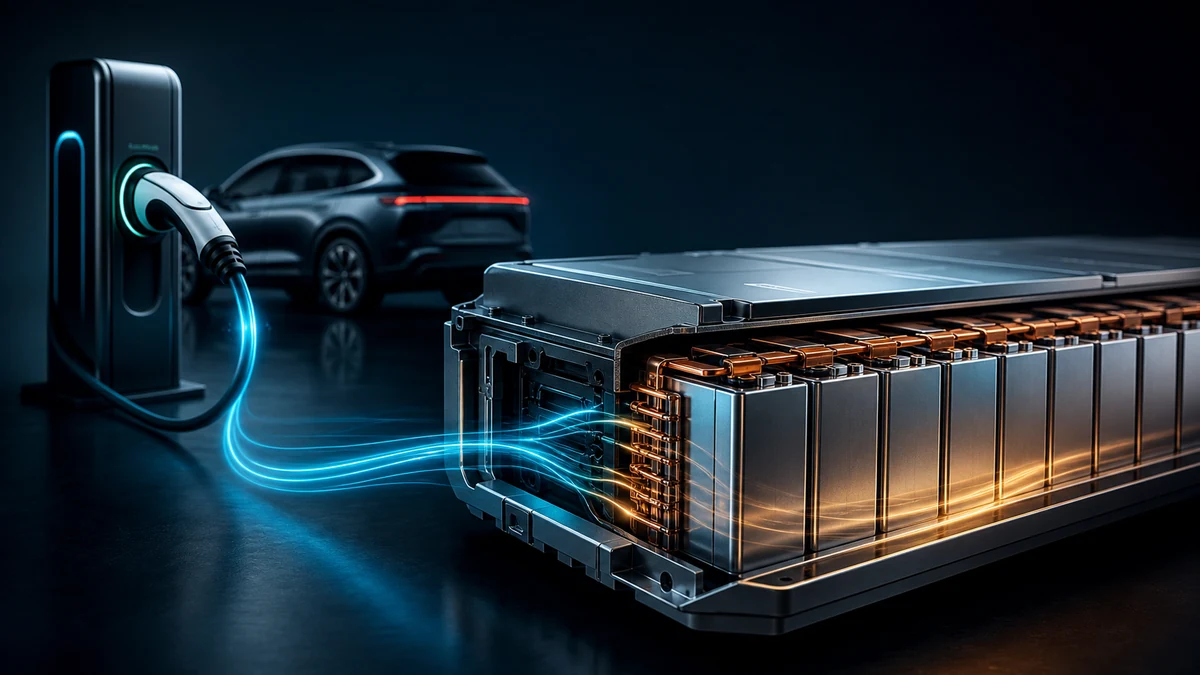
BYD introduced its second-generation Blade Battery and FLASH Charging technology in March 2026. For overseas buyers, the important point is not a headline charging time alone: the result depends on the exact vehicle, battery, charging hardware, state of charge, temperature and a compatible high-power charging station.
This guide separates manufacturer claims from vehicle-specific checks, lists model families publicly announced with the technology, and explains how to verify a used-car listing before quotation.
What BYD announced
In its March 2026 launch material, BYD says the second-generation Blade Battery pairs a higher-energy-density LFP pack with its FLASH Charging system. BYD states that a matched system can charge from 10% to 70% state of charge in about five minutes and from 10% to 97% in about nine minutes. At −30 °C, BYD states that charging from 20% to 97% takes about 12 minutes. The company also states a 5% improvement in energy density versus the first-generation Blade Battery.
These are BYD test and product-launch claims. They are not a universal promise for every BYD, DENZA, FANGCHENGBAO or YANGWANG vehicle, and they should not be used as a destination-market charging guarantee.
Why the charger matters as much as the vehicle
BYD describes its FLASH Charger as capable of up to 1,500 kW through one connector under the Chinese-market specification. That is station capability, not a statement that every compatible vehicle can accept 1,500 kW. A vehicle's peak DC rate, battery temperature, charge curve and the local grid all affect the result.
- Vehicle: confirm the exact trim, battery pack, model year and DC charge specification.
- Station: confirm connector, voltage/current capability and real operating availability at the destination.
- Conditions: state of charge, pack temperature, weather and charging-session settings can change the result materially.
Manufacturer-announced model examples
The table below is a practical sourcing reference, not a complete worldwide availability list. Second-generation Blade Battery availability can vary by trim, model year and sales market. Always confirm against the VIN, factory build information and vehicle-specific battery/charging configuration.
| Brand family | Publicly announced examples | What to verify before quoting |
|---|---|---|
| DENZA | All-new Z9GT; second-generation D9; N9 Flash Charge Edition; N8L Flash Charge Edition | Market-specific version, charging architecture and battery specification |
| BYD | 2026 Seal 06 GT; Sealion 05 EV; Seal 07 EV; Datang EV | Exact China-market trim and production/configuration record |
| FANGCHENGBAO | Bao 5 Flash Charge; Bao 8 Flash Charge; Tai 3 Flash Charge | Whether the supplied vehicle is the Flash Charge version |
| YANGWANG | 2026 U7; 2026 U8 | Vehicle-level maximum DC power - do not assume charger maximum equals vehicle maximum |
For the source announcements behind these examples, see DENZA Z9GT, DENZA N9 Flash Charge Edition, BYD Seal 06 GT, FANGCHENGBAO Bao 5, and YANGWANG U7. Product pages and specifications can change; the supplied vehicle documents remain decisive.
Do not confuse 2025 Super e-Platform cars with a blanket Blade Battery 2.0 claim
BYD's 2025 Super e-Platform launch described 1,000 V, 1,000 A, 10C and 1 MW flash-charging architecture, introduced first on the Han L and Tang L. That launch is a different product announcement from the 2026 second-generation Blade Battery launch. A 2025 Super e-Platform vehicle should therefore not be marketed as a second-generation Blade Battery vehicle unless its exact VIN/build specification confirms it.
Recommended BYD EV models for export enquiries
Browse our recommended BYD EV models for export to compare currently listed vehicles. For related high-voltage, fast-charging examples, see the 2025 BYD Han L EV 701 km LiDAR Premium Edition and the 2025 BYD Tang L EV 670 km LiDAR Premium Edition. Their source specifications list 1,000 kW DC fast charging and a six-minute fast-charge figure. These internal links are deliberately described as related Super e-Platform examples; they are not an assertion that every listed vehicle carries the second-generation Blade Battery.
Export-buyer verification checklist
- Match the VIN, model year, build month and exact trim against the seller's source record.
- Ask for the battery chemistry, pack capacity, charging architecture and vehicle-level DC charging specification.
- Confirm whether the destination's connector, charging voltage and station network can support the intended use case.
- Check the battery warranty position, diagnostic record, first-registration date and any market-specific software or charging limits.
- Describe charging performance as an indicative, conditions-dependent specification - never as a guaranteed refuelling-equivalent time.
Primary references
- BYD: Blade Battery 2.0 and FLASH Charging announcement, March 2026
- BYD: Super e-Platform and megawatt flash charging announcement, March 2025
- BYD China: second-generation Blade Battery launch material
Editorial note: this article is an independent sourcing guide. Vehicle availability, battery configuration and charging performance must be confirmed for each supplied vehicle before an export quotation is accepted.